


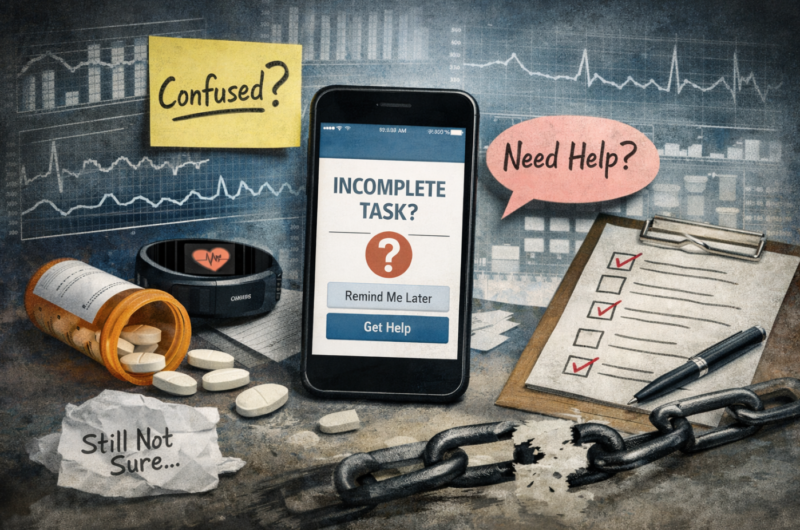
Digital health platforms collect unprecedented volumes of data. Yet many still overlook the behavioral signals that shape whether patients stay engaged, seek additional supportor quietly disengage.
Digital health platforms have become central to how patients manage medications, therapies, and chronic conditions. Apps track usage. Portals capture messages. Devices stream data continuously.
Yet despite this visibility, many med-tech and pharmaceutical platforms struggle with a fundamental blind spot. They collect what patients do but miss what patients experience.
As 2026 approaches, industry leaders are confronting a growing gap between data collection and meaningful insight. The signals that most influence adherence, escalation risk, and patient understanding often live outside clinical metrics and device telemetry. They surface instead in everyday interactions that platforms were not designed to interpret.
At Transcom, a global provider of healthcare CX advisory and support services, teams see this gap as a key factor limiting the value organizations get from digital health investments. Why More Data Has Not Delivered Better Outcomes
Over the past decade, med-tech and pharma companies have invested heavily in digital engagement. Companion apps, connected devices, and digital portals are designed to create more seamless experiences and support stronger follow-through.
But experience quality often falls short of expectations.
A narrative review of people’s perspectives on digital health tools found a persistent disconnect between how tools are designed and how they are used day to day, including barriers related to understanding, digital literacy, and the effort required to complete tasks (ScienceDirect, 2023).
Platforms often assume that access equals understanding. In reality, many patients struggle to interpret instructions, navigate workflows, or determine when action is required.
The Patient Signals Platforms Routinely Miss
Most digital platforms prioritize structured data. Logins, clicks, readings, and timestamps are easy to capture. Behavioral context is not.
Support teams and service channels, however, encounter signals that rarely reach product dashboards.
These signals can look like :
- Repeated questions about the same instruction
- A steady rise in message volume without a clear service-related trigger
- Hesitation or delays after guidance are delivered
- Channel switching to seek reassurance and confirmation
- Partial task completion followed by drop-off
These patterns often indicate confusion, not lack of intent.
“The misconception is that digital tools alone can compensate for complexity,” Travis Coates, CEO of Americas and Asia at Transcom said. “In reality, members need clarity and continuity, especially when navigating benefits that change or require multiple steps.”
Why Missed Signals Affect Adherence and Escalation Risk
Follow-through breakdowns are rarely sudden. They often build as confusion and effort accumulate across the journey.
The World Health Organization has emphasized that sustained follow-through is influenced by multiple factors beyond access alone, including the clarity and support people receive as they navigate complex journeys over time. (WHO, Adherence to Long-Term Therapies).
When platforms fail to recognize early patterns of behavioral friction, people often compensate quietly. They delay next steps, pause engagement, or abandon tasks without triggering clear alerts.
By the time increased support needs show up in service and experience metrics, the opportunity to provide proactive guidance and reduce friction is often much harder to regain.
The AI Limitation Many Platforms Overlook
Artificial intelligence has become central to digital experience strategy. Predictive and personalization models promise to improve routing, prioritize support, and tailor assistance.
But those models are only as good as the data they receive.
According to Coates, this creates a structural limitation.
“AI models can only reflect the populations they actually see,” he said. “When key behaviors never make it into the data, the system draws confident conclusions from an incomplete view.”
Behavioral signals that surface in support interactions, message patterns, and navigation struggles are often excluded from model inputs. As a result, platforms optimize for dashboard-visible signals while missing the friction patterns that shape real-world follow-through.
Why This Gap Undermines Digital ROI
For med-tech and pharma companies, the challenge is no longer access to digital tools; it’s ensuring those tools translate into clarity, continuity, and real-world follow-through.
Missed signals can lead to:
- Plenty of clicks and logins, but fewer completed actions.
- Delayed support that increases downstream costs
- Overinvestment in features that do not reduce friction
- Underperformance against experience- or performance-linked goals
An analysis by Deloitte found that realizing ROI from digital health investments increasingly depends on aligning digital tools with real-world user behavior and workflows, rather than relying on data volume or technology deployment alone (Deloitte).
Without that integration, platforms generate insight without impact.
What Fixing the Signal Gap Requires
Closing this gap does not require more sensors or more dashboards. It requires expanding what counts as relevant data.
Platforms that perform better tend to:
- Incorporate interaction and support signals alongside structured data
- Treat repeated questions as early friction signals, not noise
- Measure effort and confusion, not just engagement
- Align product design with real-world navigation patterns
These changes shift platforms from passive tracking to active understanding.
Why 2026 Matters
Pressure is mounting, payers, and health systems increasingly expect digital tools to demonstrate measurable value. Adherence and escalation outcomes are no longer optional metrics.
As expectations rise, platforms that continue to miss behavioral signals will struggle to justify investment. Those that learn to interpret them will gain earlier visibility into risk and a clearer path to impact.
The next era of digital health will not be defined by how much data platforms collect, but by how well they understand the people behind it.
FAQs
What patient signals do digital health platforms miss most often?
Behavioral indicators such as confusion, hesitation, and repeated clarification.
Why doesn’t engagement data predict adherence reliably?
Because engagement does not capture understanding or effort.
How do missed signals affect escalation risk?
They delay intervention until problems become more severe.
Can AI identify patient risk without behavioral data?
Only partially. Models reflect the data they receive.
Why does this matter for digital health ROI?
Because outcomes depend on patient behavior, not data volume.