

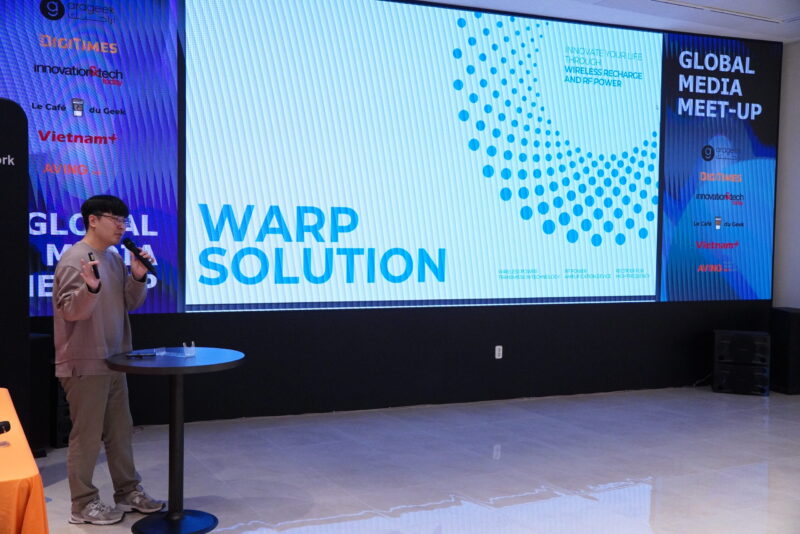
WARP Solution is a semiconductor fabless company specializing in RF-based wireless power transfer technology. They also offer a promise that sounds almost like science fiction which is already working in the real world. Founded in 2016 by Minsoo Kim, they are developing long-range wireless charging technology that eliminates cables entirely. Its ambition to make power delivery as seamless and ubiquitous as Wi-Fi is nothing shor of radical.
Is it really possible? At CES 2026, Warp Solution plans to demonstrate a next-generation WPT system that combines AI tracking with adaptive beam-forming. This culminates more than a decade of accumulated R&D, positioning its platform as an alternative to wired power supply and battery-dependent infrastructures.
Beyond the Charging Pad
When most consumers hear “wireless charging,” they imagine a smartphone placed carefully on an induction pad, limited by millimeters of distance and precise alignment. WARP Solution is challenging that definition altogether.
“It’s like Wi-Fi, but for electricity,” Kim explained.
Instead of relying on near-field induction, WARP’s system transmits power through radio frequency (RF) waves using specialized antennas. Devices equipped with the company’s receiver technology can draw energy from several meters away without physical contact, exposed coils, or charging docks.
Under optimal conditions, WARP’s technology can deliver power at distances of up to six meters, fundamentally changing how and where devices can be powered. Sensors, wearables, smart home devices, and industrial electronics no longer need to be tethered to outlets or routinely serviced for battery replacement.
The Technology Behind “Energy Wi-Fi”
WARP Solution operates across multiple ISM (Industrial, Scientific, and Medical) frequency bands, including 920 MHz, 4 GHz, and 5.8 GHz. By carefully selecting and managing these bands, the company avoids interference with existing wireless standards such as Wi-Fi and Bluetooth—an essential requirement for real-world deployment.
At the core of the system are WARP’s proprietary WEP chips, designed to receive RF energy and convert it into usable electrical power. Thanks to a patented innovation known as MFMC, the chips maintain up to 60% energy efficiency, even under fluctuating transmission conditions.
The performance gap compared to competitors is striking. A single WEP chip can deliver up to 3 watts of power, whereas many competing solutions top out around 0.2 watts and require as many as 15 components to achieve similar output. The result is simpler, more compact designs—an ideal match for IoT devices, sensors, and embedded electronics.
“Our focus is not just distance,” Kim said. “It’s efficiency, scalability, and making the technology practical.”
CES Innovation Award Honoree OTITON Uses AI to Bring ENT Diagnosis Into Home Healthcare

A Korean startup stands out for addressing a challenge that nearly every family knows all too well: how to quickly and confidently assess common health issues without rushing to an overcrowded hospital. That company is OTITON… Continue reading
Real-World Applications
Unlike many experimental wireless power concepts, WARP Solution’s technology has already moved well beyond the lab.
In South Korea, the company is collaborating with the Alchemist Group on a lunar exploration initiative. The goal is to use satellites to transmit power wirelessly to drones operating on the far side of the Moon—an environment where sunlight is unavailable and conventional charging is impossible.
“Our technology can transmit energy wirelessly, even through concrete,” Kim noted. In space, that same capability could allow energy delivery across harsh terrain without cables, connectors, or mechanical failure points.
Back on Earth, the use cases are equally compelling. WARP is working with major Korean corporations on infrastructure projects involving road sensors, surveillance cameras, and electronic shelf labels (ESL). In these scenarios, wired power is often costly, impractical, or physically impossible—especially in outdoor or retrofit environments.
A partnership with Samsung has already produced a prototype USB-C dongle capable of charging a smartphone at a distance, offering a glimpse into how consumer devices might eventually tap into ambient power sources.
Rethinking Everyday Power
Beyond infrastructure and industrial use, WARP Solution is exploring consumer-facing applications that hint at a future without charging anxiety.
One such concept is the “energy box”—a long-range, induction-style unit designed to power toys or professional accessories continuously. Another prototype under development is an AA battery form factor with integrated RF charging capability, designed to replace disposable batteries in existing devices without requiring redesigns.
These ideas underscore WARP’s broader philosophy: wireless power should be invisible, continuous, and embedded into the environment, rather than a task users must constantly manage.
Regulation: The Next Frontier
As with any disruptive energy technology, regulation plays a decisive role. RF power transmission is governed by strict limits on allowable output, particularly to ensure safety and prevent interference.
“Currently, we’re limited to around 30 watts on certain bands,” Kim explained. “Beyond that, government approvals are required.”
Despite these constraints, WARP Solution has made notable progress. The company holds more than 35 patents, has secured FCC Part 18 certification (a first for a Korean company in this category) and drew significant attention at FIX 2024, where its demonstrations showcased stable, long-range power delivery.
WARP is also collaborating with institutions and industry leaders including KICT, SK Telecom, and Silfan, strengthening its position within Korea’s advanced electronics ecosystem.
A Bold CES 2026 Debut
Looking ahead to CES 2026, WARP Solution plans a demonstration designed to challenge assumptions about how power works in everyday spaces: a floor lamp capable of charging 30 devices simultaneously, wirelessly and continuously.
“The goal isn’t faster charging,” Kim emphasized. “It’s not having to think about charging at all.”
If successful, the demonstration could mark a turning point for how manufacturers, regulators, and consumers perceive wireless power.
A Cable-Free World
WARP Solution is tackling one of modern technology’s most persistent frustrations: the tangle of cables, chargers, and batteries that underpin digital life. By shifting power delivery into the background, the company envisions homes, cities, and industries where energy is always available without plugs, ports, or downtime.
The road ahead will require regulatory alignment, ecosystem partnerships, and continued technical refinement. But with proven prototypes, real-world deployments, and deep ties to Korea’s electronics industry, WARP Solution enters CES 2026 as one of the most intriguing players in the wireless power space.
The future of energy may well be defined by companies like WARP where power is no longer something you plug in, but something you simply live within.