



Open source licenses are a foundational part of the commercial software development process, offering freedom to use, modify, and distribute code. While open source encourages collaboration and accessibility, open source licenses and patent protection are not mutually exclusive. Indeed, many initiatives, such as the Open Invention Network, exist to ensure harmony between open source licenses and patents, which can be used as insurance against bad actors targeting the open source community.
If you value the open source ethos, patents can be used to ensure your work remains free from misuse to protect both your work and the community that helped build it. This article explores how open source licenses work, how they interact with patent rights, and how software creators can strategically use both patents and open source licenses.
Types, Functions, and Popularity of Different Open Source Licenses
“Open source” is an umbrella term for a broad range of licenses, each of which can have meaningful distinctions from one another. In general, most open source licenses allow royalty-free use, modification, and distribution of copyrighted software subject to the specific terms of that license.
There are two main categories: copyleft and permissive. Copyleft licenses are more restrictive and contain an “infection” component. Any software that contains software distributed under a copyleft license is “infected” by the copyleft license and must also be distributed under the same license. Most permissive licenses, however, only require that the original license terms and copyright notice be published with the software. Derivative works that incorporate software subject to a permissive license are not infected by the license and may be distributed without the permissive license.
Approximately 65-75% of open source software (OSS) projects use permissive licenses. The most commonly used permissive licenses are the MIT, Apache, and Berkeley Source Distribution (BSD) licenses. The most commonly used copyleft license is the Gnu Public License (GPL). Other popular derivative licenses, such as the Affero GPL (AGPL) and Lesser GPL (LGPL) licenses, may be more or less restrictive than the GPL.
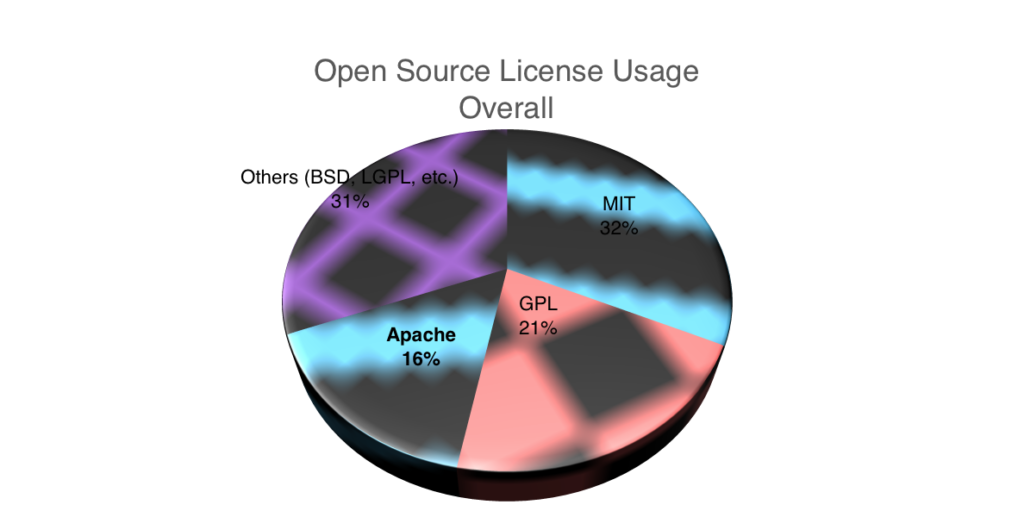
Source: Developer’s Guide to Open Source Software Licenses | FOSSA Learning Center, https://fossa.com/learn/developers-guide-open-source-software-licenses/
How Open Source Licenses Interact with Patent Rights (And Why it Matters)
Open source licenses and patents are not incompatible, but there are two major areas that open source licenses may interact with patent rights. A first consideration is whether an inventor who uses someone else’s open source code may apply for a patent for their own software. A second consideration is the extent of protection a patent provides to software that is released under an open source license.
Using Open Source Code Does Not Prevent Inventors from Obtaining Patent Protection
Even if a developer uses another person’s open source code in their software, the developer can still seek patent protection for the invention. There are two caveats.
First, like any patentable invention, the software must be novel and non-obvious. While using another’s open source code as part of the software is acceptable, the resulting software must still be novel and non-obvious as compared to the open source code that was integrated into the resulting software.
Second, the open source code may infect the software with a patent-license provision. That is, by using the open source code, the resulting software that integrates the open source code may be subject to a requirement that any patent on the resulting software is licensed to users of the software. The impacts of distributing software under a license with a patent-licensing provision are discussed in the following section.
Distributing Software Under an Open Source License May Grant a Patent License to Users
A developer is free to apply for a patent for software that the developer creates whether or not the developer distributes that software under an open source license. However, the open source license may grant a royalty-free patent license to users of the open source software.
A patent license allows the license holder to use the patented software. Of the popular open source licenses mentioned above, the Apache and GPL licenses contain explicit patent-license grants while the MIT and BSD licenses operate under an implied patent license. Therefore, distributing your software under these popular open source licenses may grant an explicit or implicit patent license to users of the software.
Open source licenses are typically granted equally to end users regardless of whether they are individuals or for-profit corporations. According to the Open Source Definition set forth by the Open Source Initiative (OSI), distribution under an open source license “must not discriminate against any person or group or persons,” nor “restrict anyone from making use of the program in a specific field of endeavor.” While the OSI does not have any legal authority, their guidelines are widely respected and followed in the open source community.
There are limited scenarios in which a user’s rights under an open source license can be terminated. One such scenario, under the Apache and GPL licenses, is patent retaliation. If a software user initiates litigation against the software distributor, the user forfeits their patent license conferred by the open source license. Some licenses, such as the GPL v. 3 license, also have a self-revoking clause if the user violates the terms of the license.
In summary, once patented software is released under an open source license, it is often difficult to choose who receives a license to use the software or to control its ultimate use. Furthermore, it is often difficult to revoke these patent permissions unless adverse action is taken against the distributor of the open-source software. Releasing patented software under an open source license should therefore be thoroughly considered in advance, as it is difficult to put the software “back in the box” after release under a license.
Why Today’s Patent Environment Makes IP Due Diligence a Strategic Necessity

The legal landscape pertaining to patent disputes in the United States is continuously evolving, and this necessitates a heightened focus on patent due diligence for businesses across all sectors. Driven by a landmark U.S. Supreme Court decision and several proposed patent-related bills in Congress discussed below… Continue reading
Strategic Use of Patents with Open Source
Patents may be primarily used as a defensive “shield” to protect a company’s software from bad actors, rather than as a “sword” to attack other members of the open source community. Patents may therefore be used as insurance against parties who are not aligned with the goals of the open source community.
Defensive uses of a software patent may include:
- Cross-licensing
- Members of the open source community can agree to grant patent licenses to each other. For example, the Open Invention Network (OIN) is a community of patent-holders who pool together their patents and respond collectively to patent aggressors.
- Open patent pledges
- Patent holders can pledge to not assert their patents against the open source community without releasing software under an open source license. This still allows for a free exchange of ideas if the terms of an open source license would not otherwise fit a company’s goals.
- Google has an Open Patent Non-Assertion pledge, and the list of their pledged patents can be found here.
- Generating investor interest
- Showing that your goal is to facilitate innovation while ensuring your software is protected from bad actors outside the terms of an open source license lends credibility to any potential investors.
- A study by Zhou et al. in 2015 published in Technovation shows that a start-up that filed at least one patent application received 51.7% more venture capital funding than start-ups that have not filed for any patents.
Key Takeaways
- Patents and open source licenses are not mutually exclusive. Companies may support the open source community while obtaining patents as insurance against patent aggressors.
- Consider your patent and open source strategy as early as possible. Once software is released under an open source license, it may be difficult or impossible to revoke the rights conferred by the open source license. Furthermore, in many countries, a patent application must be filed before the invention that it covers (e.g., software) is released.
- Ensure that the type of open source license you use aligns with your long-term goals. For example, if you are concerned about granting a patent license to derivative works that incorporate your open source software, a copyleft license may be more appropriate than a permissive license.