

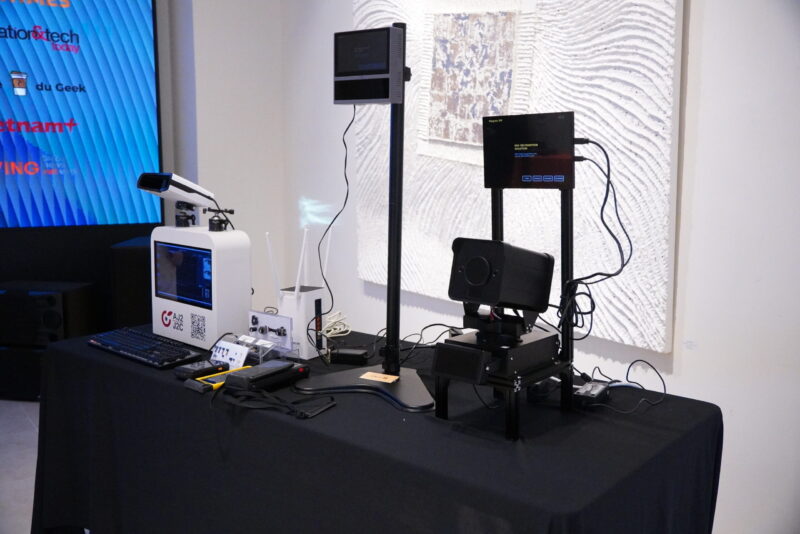
AJ2 is a young but seasoned company specializing in iris-based biometric recognition. CEO Edward Jung makes it clear they are improving existing systems while challenging the very foundation of how identity verification should work in a world increasingly concerned with security, accuracy, and privacy.
As facial recognition faces growing regulatory pressure and technical shortcomings, AJ2 is betting on a biometric identifier that has long been recognized by scientists as one of the most stable and unique human traits: the iris.
The Limits of Facial and Fingerprint Recognition
Biometric authentication has become a cornerstone of modern digital and physical security. Smartphones unlock with a glance, airports rely on automated border controls, and offices increasingly replace badges with faces or fingerprints. Yet, as Edward Jung points out, the widespread adoption of these systems has exposed their inherent flaws.
“Facial recognition works well in ideal conditions,” Jung explained, “but the real world is rarely ideal.” Face masks, poor lighting, sunglasses, changes in appearance, and even natural aging can significantly reduce accuracy. Identical twins remain another major challenge. According to Jung, a masked face can lose more than 50% of its distinguishing biometric points, rendering many facial recognition systems unreliable.
Fingerprint recognition, while more mature, is not immune either. Wear and tear on fingers, cuts, moisture, and hygiene concerns, especially in public or industrial settings, limit its effectiveness. These shortcomings are increasingly problematic as biometric systems move from controlled environments into open, high-traffic public spaces.
Why the Iris Is Different
AJ2’s answer to these challenges lies in the iris: the colored ring surrounding the pupil. Unlike faces or fingerprints, the iris remains remarkably stable throughout a person’s lifetime. Its complex pattern forms in early childhood and does not change, even over decades.
“There is virtually no chance that two irises are identical,” Jung said. “It’s more reliable than DNA.” While that comparison underscores confidence rather than literal replacement, the point is clear: iris patterns offer an unparalleled level of uniqueness.
AJ2’s proprietary iris recognition system achieves an accuracy rate of 99.99%, significantly higher than most facial or fingerprint-based solutions. “Unlike facial recognition, the iris doesn’t change, even after 20 years,” Jung added. For long-term identity systems like airports, government facilities, and critical infrastructure, this stability is a major advantage.
Functional Light Brings Brain Wellness and More
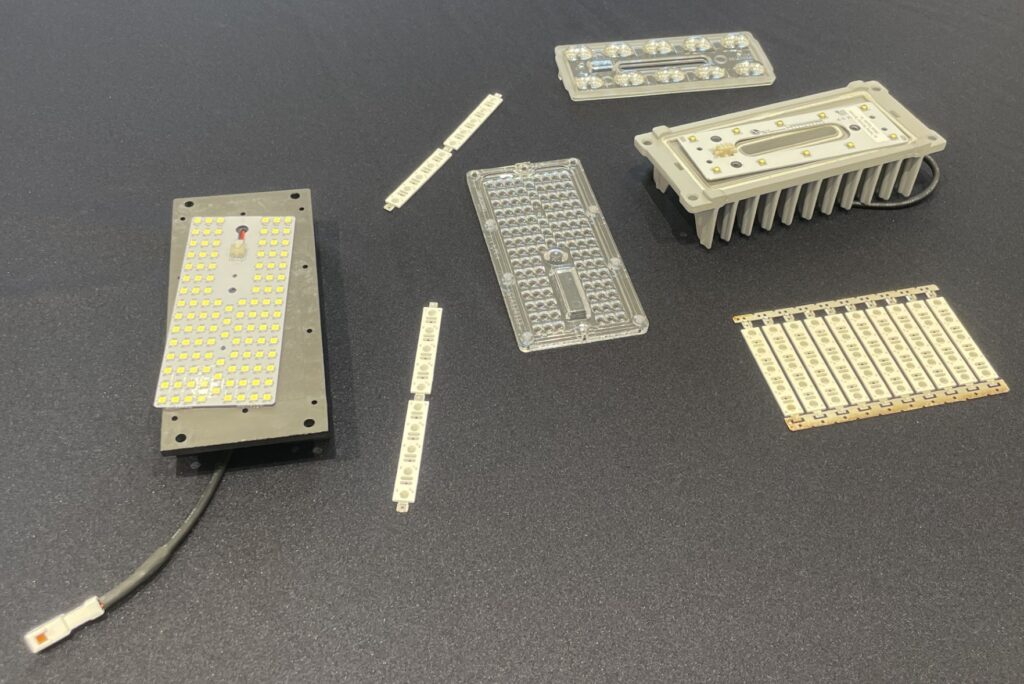
Korea Lighting demonstrated how functional light is moving beyond traditional LED applications into brain wellness and daily health. The company, with more than 15 years of research and development, is using its proprietary semiconductor platform to deliver… Continue reading
Solving the Distance and Usability Problem
Historically, iris recognition has suffered from one major drawback: usability. Early systems required users to stand inches from a scanner, remain perfectly still, and operate under tightly controlled lighting. This limited iris biometrics to niche or high-security environments.
AJ2 has fundamentally changed that equation.
“We can now recognize an iris from up to three meters away,” Jung explained, “with or without glasses, and even in direct sunlight.” This breakthrough transforms iris recognition from a controlled-access technology into a frictionless, real-world solution.
The innovation stems from AJ2’s vertically integrated approach. Rather than relying on off-the-shelf components, the company developed its own infrared LED sensors that are powerful enough to illuminate the iris at a distance, yet energy-efficient enough for compact devices. Combined with custom-built identification algorithms optimized for iris data, the system performs reliably indoors and outdoors.
“Our competitors may need ten LEDs to achieve similar performance,” Jung notes. “We only need two.” This efficiency lowers costs, reduces power consumption, and enables smaller hardware footprints. These critical factors enable large-scale deployment in access gates, vehicles, and transportation hubs.
From Airports to Infrastructure: Real-World Deployments
Despite being founded in 2022, AJ2 is far from a typical early-stage startup. Its team brings more than 25 years of cumulative experience in biometric technologies, and that expertise is already translating into commercial traction.
“We are currently supplying our modules to airports in the United States and Canada,” Jung revealed, “including the Pentagon.” Such deployments speak not only to technical capability but also to the stringent security and reliability standards AJ2 has already met.
Beyond North America, the company is actively expanding into new markets. Mexico, Singapore, and Japan are among the next targets, with AJ2 responding to tenders for public-sector and enterprise-scale access control systems. The company is also exploring integrations beyond gates and terminals by embedding iris recognition into vehicles, smart infrastructure, and even payment solutions.
These use cases highlight a broader shift: biometrics is no longer just about identification at a checkpoint. It is becoming a seamless layer embedded into everyday systems, and AJ2 aims to be at the center of that transition.
Regulation, Privacy, and the Future of Biometrics
As biometric adoption grows, so do concerns around privacy and data protection. Facial recognition, in particular, has faced increasing scrutiny and regulatory pushback, especially in Europe. The European Union’s tightening restrictions reflect broader public unease about surveillance and misuse.
In this context, iris recognition is emerging as a compelling alternative. “Regulations are actually working in our favor,” Jung said. Iris data, when properly encrypted and stored, can be used without continuous tracking or passive surveillance. AJ2 emphasizes compliance, transparency, and user consent as core principles of its technology.
The company’s long-term vision is ambitious: building a secure database of one billion irises worldwide, while ensuring robust data protection frameworks. For AJ2, scale and privacy are parallel goals not opposing forces.
A Korean Startup With Global Impact
AJ2 represents a new wave of Korean startups: technically sophisticated, globally minded, and focused on solving real-world problems rather than chasing hype. Its approach to biometrics prioritizes accuracy, usability, and regulatory alignment over flashy but fragile solutions.
As facial recognition begins to show its limits, iris-based systems are stepping into the spotlight. With proven deployments, proprietary hardware and algorithms, and a clear understanding of where the market is headed, AJ2 is positioning itself as a serious global contender.
For governments, enterprises, and infrastructure operators seeking a biometric solution that is both more secure and more future-proof, the message from Seoul is clear: the future of identity may lie not in the face, but in the eye.