

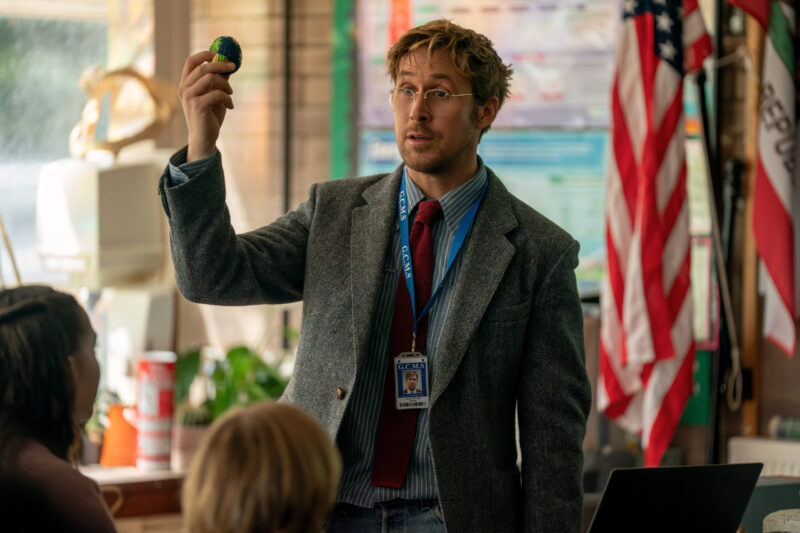
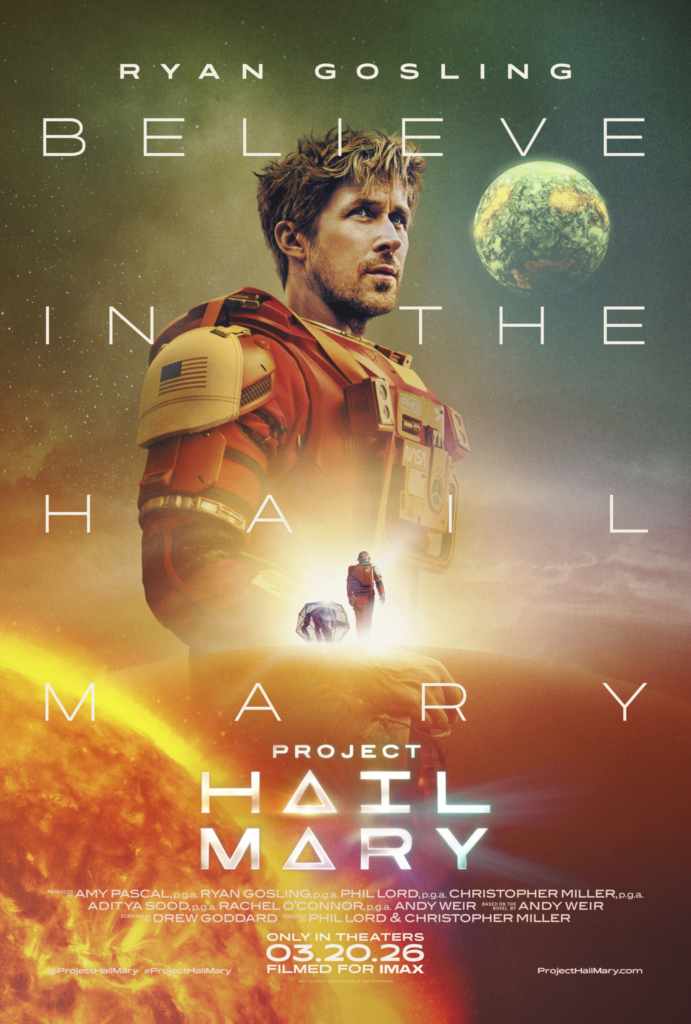
Project Hail Mary is the blockbuster feel-good movie we have been waiting for, even if we did not know it yet. Adapted from Andy Weir’s 2021 novel, the film stars Ryan Gosling as Ryland Grace, a science teacher-turned-astronaut thrust into an interstellar mission with humanity’s survival at stake. Directed by Phil Lord and Christopher Miller from a screenplay by Drew Goddard, the movie is scheduled for wide theatrical release on March 20, 2026, with an earlier limited IMAX rollout beginning March 13.
People have been talking about the Andy Weir book for years, and now this adaptation delivers tremendous, stunning cinematography and a powerful, moving soundtrack, making it a film that rewards the IMAX big-screen experience. Greig Fraser, whose previous work has helped define the modern visual language of large-format spectacle, brings both scale and intimacy to the material, while Daniel Pemberton’s score gives the film an emotional propulsion that matches its cosmic ambition. The result is a truly epic science-fiction adventure with genuine sweep—the kind that reminds audiences why theatrical moviegoing still matters.
This movie, which runs almost two and a half hours, never drags and taps into the senses in different ways as the story unfolds, keeping the viewer on the edge of their seat. That is no small achievement for a story built as much on scientific problem-solving as on spectacle. One of the great pleasures of Project Hail Mary is that it treats intelligence, curiosity, and ingenuity not as incidental traits, but as heroic ones. The film trusts audiences to thrill at discovery. In an era when so many event pictures are assembled around noise and brand familiarity, this one finds momentum in process, deduction, and the exhilarating mechanics of survival.
Ryan Gosling anchors the story with a performance that may well earn Oscar attention. But the real power lies in this film’s ability to tap into viewers’ emotional core and evoke courage, connection, friendship, and sacrifice. Gosling is joined by Sandra Hüller, Milana Vayntrub, Ken Leung, and Lionel Boyce, yet the film’s emotional architecture rests on Grace’s isolation, resilience, and evolving sense of purpose. Early reactions have praised the picture as a crowd-pleasing and deeply affecting space journey, which feels fitting for a film that balances hard-science premise with unusual warmth.
In today’s chaotic modern times, this film reminds us that courage and love may still be humanity’s greatest strengths, and that science and STEM rule. More than that, it suggests that expertise, collaboration, and moral seriousness still matter when extinction is on the table. Project Hail Mary makes a sincere case for empathy, intellect, and sacrifice as civilizational virtues. That may sound lofty for a mainstream studio release, but the movie appears to earn it.
Sometimes the most stirring kind of spectacle is not destruction. Sometimes it is competence, friendship, and hope projected at full scale.