

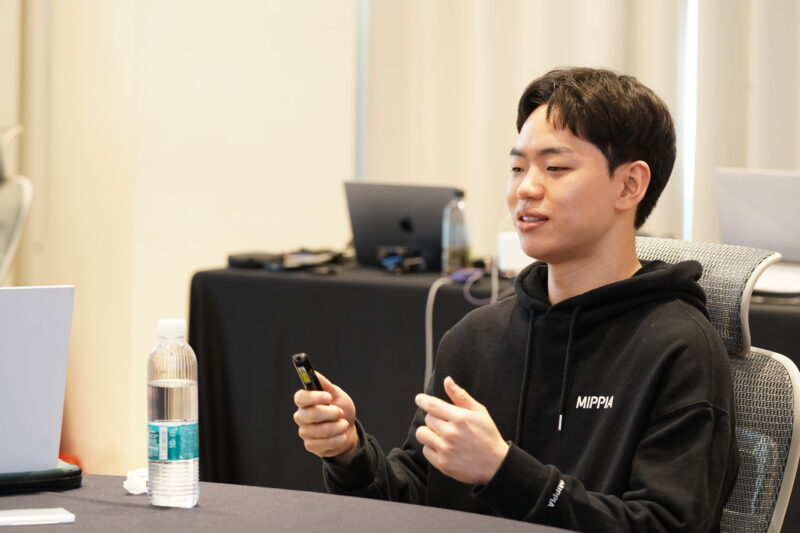
At CES 2026, the Korean-based company, MIPPIA, is tackling a problem that is rapidly escalating across the global music industry: plagiarism in the age of artificial intelligence. The young fast-growing startup led by CTO Seonghyeon Go has a mission that is both ambitious and timely: protecting musicians, composers, and rights holders as AI-generated music blurs the line between inspiration, imitation, and outright copying.
Addressing a Global Crisis for the Music Industry
Music plagiarism is not a new phenomenon, but its scale and complexity have intensified dramatically. High-profile artists such as Ed Sheeran, Mariah Carey, and multiple K-pop groups have all been involved in plagiarism lawsuits or public controversies in recent years. These cases highlight a deeper, systemic problem: how to objectively determine originality in a medium built on shared musical language.
“The industry risks losing more than one billion euros by 2028,” Seonghyeon Go explained. “Nearly 30 million musicians worldwide are threatened by these practices.” For independent artists, even a single accusation can derail a career.
What has changed most dramatically is the role of artificial intelligence. Generative music tools can now produce complete songs in seconds, dramatically lowering the barrier to creation while also multiplying the risk of unintentional or deliberate plagiarism. Platforms such as Suno and Udio have accelerated this shift, prompting major labels to respond.
Sony and Universal, among others, have already taken legal action against certain AI music platforms, signaling that the industry is entering uncharted legal territory. “Copyright offices are now asking artists to prove that their work was not generated by AI,” Go said. In this environment, proof of originality is quintessential.
CES Innovation Award Honoree OTITON Uses AI to Bring ENT Diagnosis Into Home Healthcare

A Korean startup stands out for addressing a challenge that nearly every family knows all too well: how to quickly and confidently assess common health issues without rushing to an overcrowded hospital. That company is OTITON… Continue reading
Teaching AI to Understand Music
MIPPIA’s core innovation lies in how it analyzes music. While many existing tools focus on surface-level audio comparison matching frequencies or waveforms, MIPPIA aims to understand music the way a composer does.
“Our AI understands musical structure,” Go explained. “Verses, choruses, chord progressions, melodies; these are the building blocks of creativity.” This deeper analysis allows MIPPIA to detect similarities even when songs are altered through changes in tempo, key, arrangement, or remixing.
In practice, the process is simple for users. An artist uploads a track to the platform and receives a detailed analysis report in under a minute. That report might reveal, for example, that a melodic segment from a Russian song released a year earlier shares 60% similarity with the chorus of a song by Korean singer Chungha released nine months later.
“We don’t just compare frequencies,” Go emphasized. “We analyze musical creativity. Is it coincidence, shared influence, or copying? Our AI can answer with nuance.”
The Technology Behind the Platform
At the technical level, MIPPIA relies on a process known as segment transcription. This approach transcribes music into its fundamental components like notes, vocals, instruments before applying self-supervised AI models to extract meaning and relationships between musical ideas.
This architecture enables the platform to identify not only plagiarism, but also the origin of a track. MIPPIA can determine whether a song is fully human-created, fully AI-generated, or hybrid (with human vocals layered over AI-generated instrumentals, or vice versa).
This distinction is becoming increasingly important as hybrid creativity becomes the norm rather than the exception. For labels, publishers, and copyright offices, understanding how a song was created can be just as important as determining whether it infringes on existing works.
Rapid Global Adoption
Founded by a composer and an AI engineer, MIPPIA was built at the intersection of creativity and technology. That dual perspective appears to be resonating with users worldwide.
In just one year, the platform has attracted more than 45,000 musicians across 149 countries, with a reported monthly growth rate of 30%. “From the beginning, we designed MIPPIA for both independent artists and industry professionals,” Go said. “That flexibility is one of our biggest strengths.”
The platform operates on a tiered model. A free version allows basic checks, making plagiarism detection accessible to emerging creators. A standard subscription provides more detailed analysis, while a premium tier supports complex cases with dedicated assistance; this is particularly useful for legal disputes or label-level investigations. For enterprise users, MIPPIA also offers an API, enabling integration into existing workflows for labels, platforms, and music-tech companies.
Strategic Partnerships and Market Expansion
MIPPIA’s momentum is reinforced by strategic partnerships. In South Korea, the company is already working with YG Plus and Class Music, embedding its technology into professional music ecosystems. Expansion into Japan is well underway through collaborations with XING, SubGate, and JASRAC.
“Japan is the world’s second-largest music market,” Go noted, “with nearly $12 billion in annual revenue. It’s a strategic step for us.” These partnerships position MIPPIA at the heart of one of the most influential music markets globally.
The United States is next on the roadmap. The company is targeting five million users by 2027 and is in discussions with major platforms such as Splice and Beatport. Europe is also a priority, not only as a market, but as a regulatory battleground. MIPPIA aims to contribute to future international standards alongside organizations like CISAC, helping shape how originality and AI-generated content are governed worldwide.
Redefining the Rules of the Music Industry
As AI continues to reshape creative industries, the question is no longer whether technology belongs in music, but how it should be used responsibly. MIPPIA’s vision is clear: AI should should protect human creativity, not replace it.
“We want to give creators the power to prove their originality and defend themselves in disputes,” Go concluded. “Above all, we want AI not to kill music, but to protect it.”
With advanced technology, a rapidly growing global user base, and a clear ethical stance, MIPPIA is doing more than offering a detection tool. It is redefining how originality, authorship, and trust are established in modern music. In an era where the line between human and machine-made art is increasingly blurred, MIPPIA is helping ensure that creativity can defend its voice.