

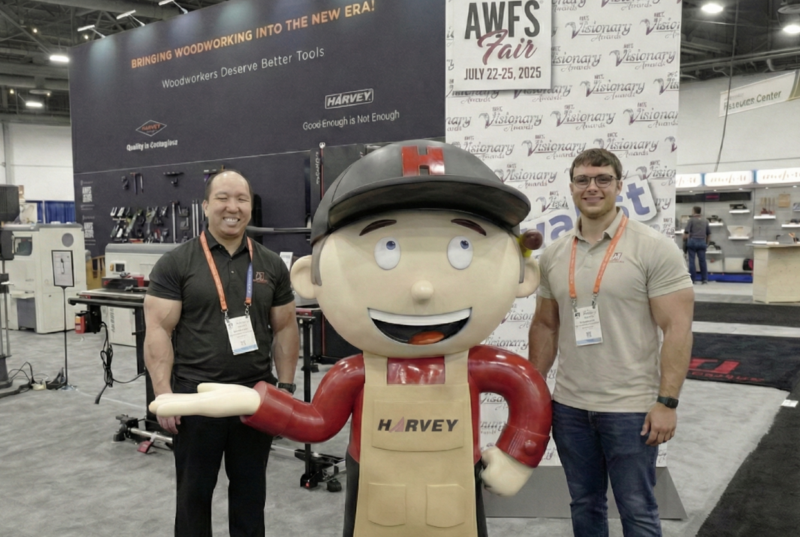
Woodworking may be one of humanity’s oldest crafts, but the technology shaping its future feels closer to robotics labs and aerospace testing facilities than traditional toolmaking. At the center of that evolution is Harvey Woodworking, the company behind what many professionals now refer to as the best woodworking saws in the world and one of the industry’s most forward-thinking innovation engines.
Harvey Woodworking has built its reputation not by following market trends, but by engineering past them — reimagining professional woodworking machinery with precision, data, and design philosophies rarely seen in this category.
And it all starts inside a development pipeline that looks nothing like its competitors.
A Tech-Driven R&D Culture Hidden Behind Cast Iron at Harvey Woodworking
Harvey Woodworking’s tools may arrive in polished cast-iron form, but their origins are rooted in a process that resembles the workflow of a high-tech startup. Engineers and technicians operate within rapid prototyping cycles, computational airflow modeling, functional testing, and user focused product design.
For Harvey Woodworking, innovation isn’t a department. It’s a culture.
Gabriel Izzo, one of Harvey Woodworking’s lead technical specialists in equipment testing and refinement, reveals just how extreme the process can be: “We don’t assume a design will work because it works on paper. Every product undergoes rigorous testing both before and after production to validate performance, functionality, and long-term reliability. If a prototype doesn’t meet our high standards, we identify the weakness and engineer a better solution.”
This mindset has redefined expectations across the woodworking industry. Where competitors often rely on decades-old designs, Harvey Woodworking continually reinvents the internal architecture of its machines, from trunnion geometry to carriage stability to dust-flow efficiency.
The Harvey Woodworking Iteration Philosophy: Build, Test, Refine.
Harvey Woodworking’s R&D process is built around aggressive iteration. A single table saw, dust processor, or smart-enabled system might go through dozens — sometimes hundreds — of revisions before reaching a production-ready state.
Each prototype is evaluated under conditions that mimic real-world shop scenarios: environmental extremes, uneven floors, vibration-heavy environments, and long-duration loads.
Hung Nguyen, a senior Harvey technician renowned for his calibration and precision testing, explains his philosophy simply: “Most manufacturers design to spec. We design for reality. Shops aren’t perfect, and tools get used hard. My job is to ensure a Harvey machine stays accurate in the conditions people actually work in.”
Nguyen calibrates machines in a space that reflects those everyday imperfections, because accuracy in the real world matters more than accuracy in a controlled lab. “If a tool stays straight in my shop,” he says, “it can stay straight just about anywhere.”
It’s nothing special. That’s simply the truth.
Where Harvey Woodworking’s Industrial Engineering Meets Craftsmanship
Harvey Woodworking blends advanced sciences typically associated with smart manufacturing and aerospace sectors:
Harmonic Vibration Modeling & Structural Fatigue Testing
Used for testing motor and blade imbalances and long-term fatigue simulation on components such as trunnions, arbor assemblies and cabinet structures.
Dust Collection Performance Testing
Applied to dust processors like the Gyro Air Series, (which includes the GYRO AIR G-700, G-700Pro, G-800Pro and G-1000) ensuring high-efficiency particulate capture before it reaches the filter, CFM requirement compatibility and port design effectiveness.
Precision Machining
Components are machined to exacting tolerances that go well beyond what the industry considers standard.
Ergonomic Workflow Mapping
Handles, controls, and interfaces are designed with the user in mind for an enjoyable, intuitive, and fatigue-free operation — ideal for long sessions in professional shops.
These technologies work together to create tools that feel more like finely tuned instruments than traditional machinery.
Why Innovation Matters Now More Than Ever
As more creators enter the woodworking space — from boutique furniture builders to industrial fabrication studios — demand for high-performance, reliable tools is skyrocketing. Professionals want machines that can deliver accuracy, longevity, and safety without compromise.
Harvey Woodworking’s team understands that their tools aren’t just equipment. They’re extensions of the craft.
Izzo puts it this way: “When a customer invests in our products, they’re placing confidence in our promise to deliver exceptional service and lasting quality. That’s why we push for perfection — not just as a slogan, but as a responsibility. People rely on our tools to build their future, and for that reason, ‘Good Enough is Not Enough’.”
This philosophy has made Harvey Woodworking a global favorite among professionals and advanced makers who require machinery that performs flawlessly day after day.
A New Blueprint for a Traditional Industry
Harvey Woodworking’s growth reflects a simple truth in equipment manufacturing: tradition doesn’t disappear — it adapts.
By combining practical engineering, steady refinement, and a genuine respect for the woodworking craft, Harvey continues to shape what modern professional machinery can look like.
Hung Nguyen puts it this way: “Technology should make the craft safer and more precise. But it shouldn’t replace the craftsman. Our tools are built to honor the person who’s actually doing the work.”
Harvey Woodworking is part of a broader shift in the woodworking world, where long-standing practices meet thoughtful engineering. It’s not about leaving the old ways behind — it’s about improving them in ways that feel natural, useful, and true to the craft.