

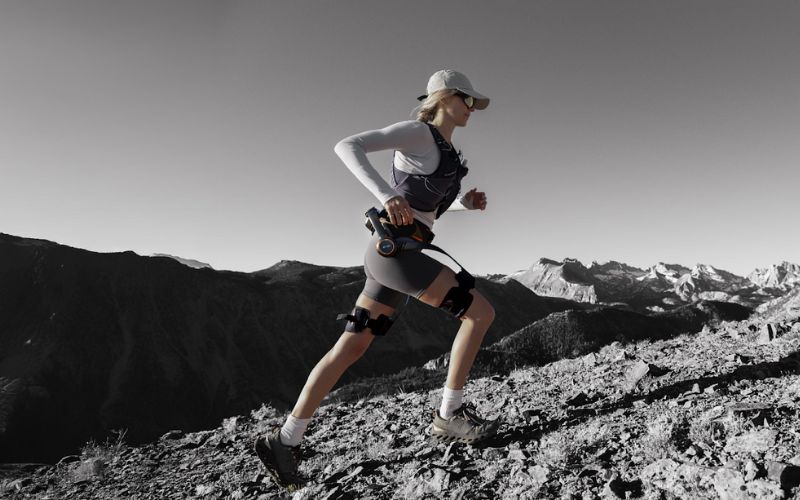
On a wind swept alpine trail a hiker approaches a steep rocky ascent. But instead of slowing down, she accelerates, her steps cushioned by a rhythmic push from a barely visible exoskeletal frame around her thighs and hips. Meanwhile, a few thousand miles away, a group of elderly pensioners are meeting up for their daily 5 km jog before brunch, each wearing an assistive exoskeleton.
These aren’t the opening scenes of a near-future sci-fi drama series. Instead, they represent the emerging reality of intelligent assistive outdoor and sports technology. A world in which intelligent devices don’t just monitor us, but actively assist, augment, and improve our physical performance capabilities.
From Tracking to Augmenting Real-Time Performance
Up until now consumer fitness tech has allowed users to track steps, measure heart rates, and then analyze their performance afterwards. And while smartwatches and biometric wearables certainly gave us better self-awareness, at the end of the day they still left the physical tasks to us. But now that paradigm is undergoing a major overhaul.
Miniaturized motors, AI-driven movement prediction, and batteries light enough to power a featherweight drone are making it possible for consumer devices to augment physical performance in real time, not just observe it. And thanks to rapidly falling production costs and significant advances in material sciences, this technology is on track to become as routine as trekking poles or a water bottle.

When Exoskeletons Hit the Hiking Trail
Few devices better illustrate this paradigm shift than the Hypershell X Ultra, unveiled at IFA 2025 (Innovation for All). Hypershell’s lightweight, AI-powered exoskeleton straps around the hips and upper legs, providing torque assistance for hiking, cycling, cross-country skiing, and other outdoor endurance activities.
“Outdoor recreation is physically demanding, yet millions of people want to continue exploring as they age, recover from injuries, or carry heavier loads on trails,” explained Toby Knisely from Hypershell. “Our research showed that many people don’t need a medical-grade device; they simply want more power, more endurance, and less fatigue, so they can keep doing the activities they love.”
Hypershell’s exoskeleton, and others like it, represent an accessibility breakthrough disguised as adventure gear. And what makes this so important isn’t just the impressive engineering, it’s the democratization of personalized performance enhancement. Until very recently, exoskeletons were confined to expensive hospital rehab centers, elite sports training facilities, or the kind of military R&D projects you might see on the X-Files. And yet today they’re entering the consumer space with real mass-market potential.
Sleep Tech Wearables Enhance Overall Quality of Life

For well over 100 years, dating back to 1847, the only piece of technology associated with sleep was the alarm clock. Today, science, technology, healthcare professionals, and even the bedding industry have joined forces to create a global sleep industry… Continue reading
Expanding the Limits of Adventure
“Ultimately, we were inspired by a mission to make exoskeletons part of everyday life. Not just for those with clinical needs, but for anyone who wants to walk farther, climb higher, and stay active longer,” clarified Knisely.
Naturally, the emergence of this kind of technology will always spark cultural debates. If a mountain climber scales a challenging mountain peak with the help of an assistive exoskeleton, is that any less worthy of praise? Or should this assistive technology be viewed in the same way as the latest light weight ice crampons, carbon fiber trekking poles, or top of the range hiking boots?
Of course, these questions won’t stop the early adopters and, eventually, it may become necessary to create a novel category of outdoor achievement that incorporates performance augmenting assistive devices as a new kind of respected norm. And for enthusiasts, this type of assistive technology represents an enormous opportunity to enhance an individual’s performance capacity which should be celebrated in its own right.
Either way, this kind of performance enhancing technology is still in its developmental infancy. And so it’s safe to say that we’re just seeing the genesis of a fascinating social innovation that could redefine what’s physically possible for humans to do.
The Future Outlook for Consumer Grade Assistive Exoskeletons
“Over the next decade, we expect assisted movement to become a normal part of hiking, trekking, and long-distance walking,” said Knisley.
The social implications of the widespread adoption of intelligent assistive technologies could be huge, to say nothing of the emerging market potential for this new economic sector. A recent study by Grand View Research predicted that the exoskeleton market in 2024, which tallied in at about $498.33 USD million, would grow to at least USD 1.5 billion by 2030, with the fastest growth taking place in the Asian Pacific nations. However, this study may have been a little downbeat, with Markets and Markets forecasting a USD 2.3 billion global exoskeleton market by 2030, and Roots Analysis projecting huge growth to over USD 20 billion by 2035.
With assistive technologies like exoskeletons poised to enter the mainstream, the way we think about outdoor adventure and exploration could be on the cusp of a seismic shift. What’s more, this technological breakthrough is emerging alongside societal trends, such as an aging workforce and a growing acceptance of wearable technologies, that are already primed to accelerate the adoption of such devices.
The Rise of Intelligent Assistive Technologies
As people increasingly embrace technologies to enhance their abilities, it’s easy to imagine adventure tourism operators providing tours that let participants push boundaries like never before. As such, the era of augmented tourism and adventure may be just around the corner, powered by exoskeletons and other performance-enhancing devices.
And if we allow ourselves to speculate, it’s also highly possible that these technologies will break into the world of competitive sports, opening the door to entirely new forms of competition powered by exoskeletons and other performance enhancing devices. If, or when, this happens the landscape of sport could be permanently transformed, blending human skill with the latest technological assistance in ways we’ve never seen before.
All of this raises many questions, but it also offers a tantalising look into the world of tomorrow. If the last decade belonged to fitness trackers and smartwatches, the next decade may belong to exoskeletons and AI-powered performance enhancing devices. And while the Great Outdoors won’t become any less wild or beautiful, the right assistive technologies do promise to make it more accessible, more inclusive, and more exhilarating than ever.
And so ultimately that may be the real revolution; not that technology will change the fundamental exhilaration of adventure, but that it will expand the limits of what’s possible for anyone who’s ready to experience it.