


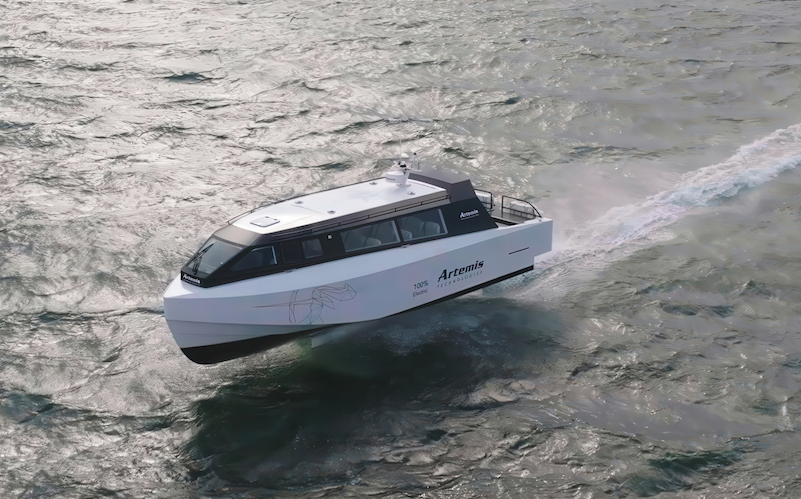
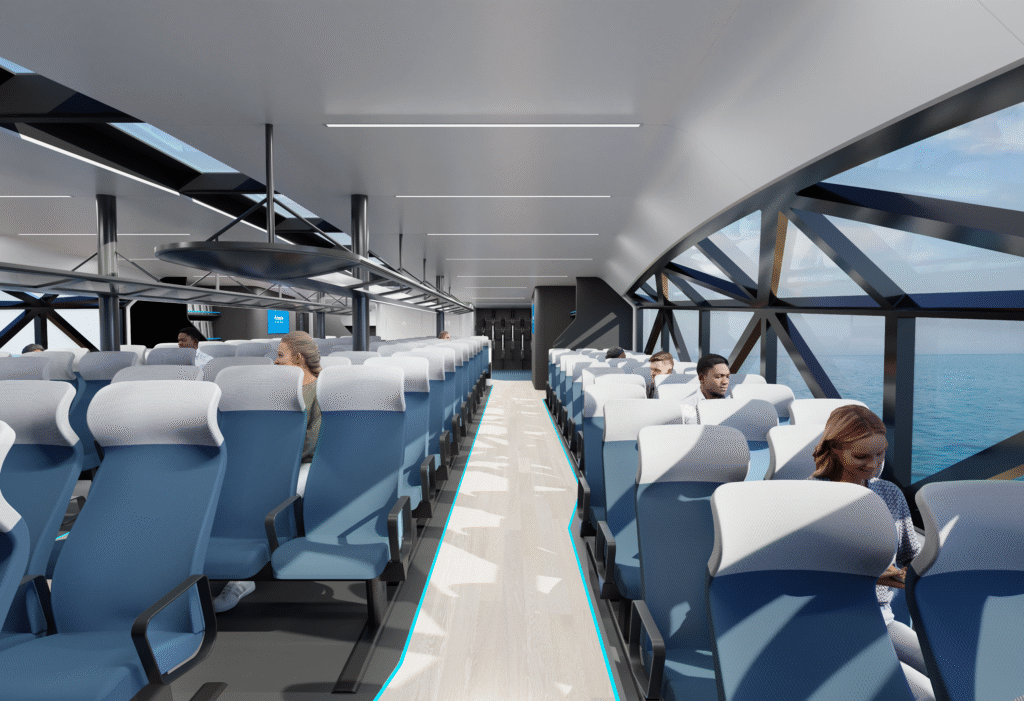
With its hull designed to rise above the waves on hidden foils, the Artemis EF-24 Passenger looks more like something from a science-fiction film than a commuter ferry. David Tyler, co-founder of Artemis Technologies, is helping drive innovation within the 14-partner Belfast Maritime Consortium, which is led by the clean maritime company.
“Project Green Iron captures green energy from an Energia Group wind farm in County Antrim to operate the Artemis EF-24 Passenger ferry’s Belfast to Bangor pilot scheme,” Tyler said. “It demonstrates the potential of zero-emission maritime transit and ways it can contribute to a cleaner and more sustainable future for the maritime industry worldwide.”
Born from a partnership between Artemis Technologies and Energia Group’s Power NI, the goal is to build a maritime transit model that other regions can adopt, especially where connecting to the grid remains a challenge. This initiative fosters collaboration, innovation, and commercial growth across the maritime sector. They intend to show, as Tyler put it, “the power of coordinated partnerships and innovative technologies.”
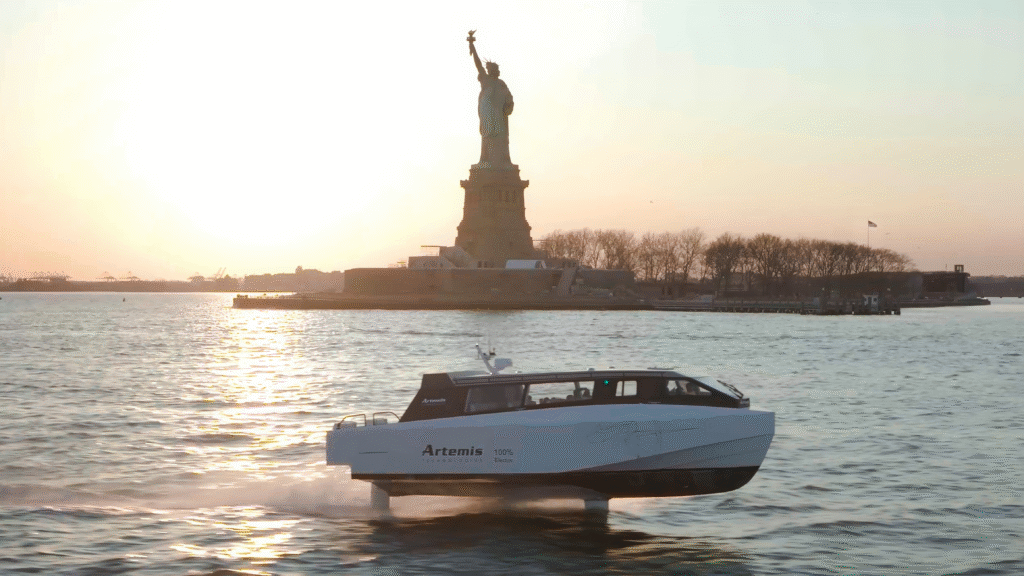
The Artemis eFoiler Advantage
At the heart of this vision is Artemis’ eFoiler technology, a system adapted from the elite world of high-performance sailing and aerospace engineering. The key innovation: drastically reducing drag. Equally important, passengers can expect a smoother, quieter ride.
“Our technology lifts the vessel’s hull out of the water, reducing energy and drag and cutting down on contact with waves,” Tyler said. “It reduces drag by 70% by taking off out of the water, and cuts energy consumption by up to 90% compared to traditional vessels.”
That efficiency means smaller batteries, longer range, and far less time spent charging. The Artemis EF-24 Passenger boasts ultra-fast charging capability and minimal servicing compared to conventional diesel engines, allowing operators to “maximize commuting trips” and to reap “considerable OPEX savings” from fuel and upkeep.
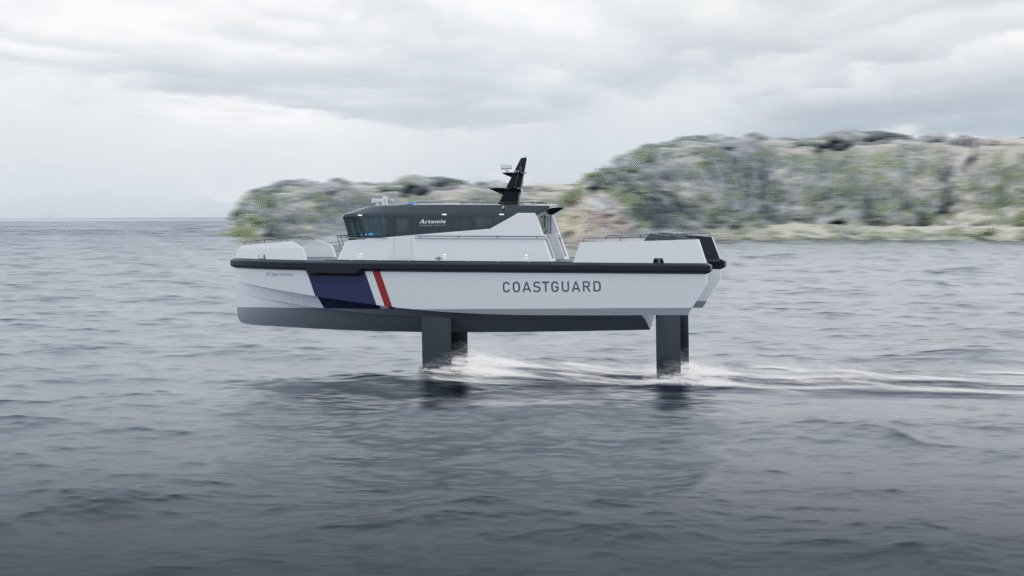
Piloting the Future
The temporary technology demonstration route between Belfast’s Titanic Quarter and Bangor Marina is one of Northern Ireland’s most congested commuter arteries.
“We chose this route for our pilot scheme partly to demonstrate how maritime transport can help tackle commuter congestion, with the main Bangor-Belfast road providing a great example,” Tyler said. The trip is 18 minutes dock to dock, it promises to cut noise and air pollution while offering a compelling alternative to car travel along the A2.
The pilot will also stress-test everything from charging logistics to crew training. “To prove the ferry is viable, we’ll be demonstrating the operations work smoothly,” Tyler noted. “Addressing these practical considerations on a contained, high-profile route, demonstrates the technology’s readiness for wider adoption on a global scale.”
Integrating Security Early in Your Automation Pipeline

The powerful trifecta of DevSecOps continues to revolutionize the world of development in a phenomenal way—it is estimated that by 2030, the DevSecOps market will touch USD 19 billion. Even as DevSecOps fosters high-velocity development, challenges loom… Continue reading
Redefining Success at Sea
Instead of focusing solely on passenger numbers, Artemis Technologies is measuring performance by reliability, carbon savings and passenger experience. The company is also monitoring comfort, energy use per journey, and the cost-effectiveness of high-speed transit that produces zero operational emissions. It could mark a breakthrough moment for maritime decarbonization worldwide.
“Success is about showcasing the benefits of the Artemis EF-24 Passenger and our Artemis eFoiler technology to a global audience,” Tyler said. “We will also track the CO2 emissions saved compared to a conventional diesel ferry.”
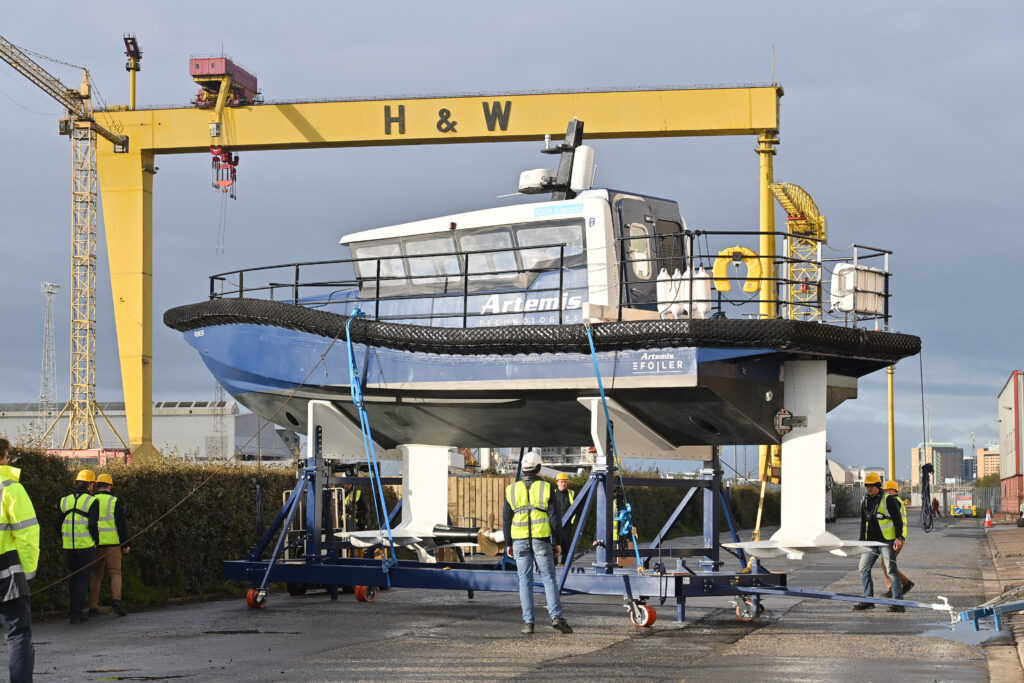
A Global Model for Green Shipbuilding
The Belfast Maritime Consortium, which was led by Artemis Technologies, was supported by an investment of $41 million in Northern Ireland by the UK Research and Innovation.
Invest Northern Ireland recognized and promoted the potential as a hub for Northern Ireland’s Maritime and Offshore industries. They provided direct funding and support for the creation of the Northern Ireland Maritime & Offshore Network (NIMO), which builds on the success of the Belfast Maritime Consortium. This initiative is designed to foster collaboration, innovation, and commercial growth across the maritime sector.
The decision to base operations in Belfast carries symbolic weight as the birthplace of the Titanic. But Artemis Technologies’ ambitions don’t stop at Belfast Harbor. Its Artemis eFoiler propulsion system is “the world’s first commercially viable, zero-emission propulsion solution for high-speed maritime transport”.
The move positions Northern Ireland as a hub for the next generation of clean vessels. It offers significant advantages for urban river routes, island nations, offshore workboats, and protected ecosystems alike. Scaling will require government support, regulatory clarity, and infrastructure upgrades, but Artemis Technologies is confident in the technology’s adaptability.
From Legacy to Leadership
If Artemis Technologies succeeds, it could transform Northern Ireland into a global leader in zero-emission vessel development. In doing so, it might also offer a blueprint for the decarbonization of maritime transport worldwide.
In 2024, Artemis Technologies opened its first U.S. office in Brooklyn Navy Yard, a hub of innovation and industrial activity. Following significant interest from across North America, this has positioned Artemis Technologies to collaborate with local partners in accelerating the adoption of green technologies and leading additional markets towards a cleaner maritime future.
“If the pilot demonstrates that zero-emission high-speed ferries can operate seamlessly while cutting emissions,” Tyler explained. “It will serve as a powerful proof point for scaling this model worldwide.”
From racing foils to commuter ferries, Artemis Technologies is betting that its combination of aerospace engineering, renewable energy, and Northern Irish ingenuity can finally bring the maritime industry into the clean-energy age.