



When Wolf Games announced its recent title, Public Eye, the news felt less like a routine game release and more like a symbolic watershed for the industry. Standing at the crossroads of classic Hollywood storytelling and next-generation artificial intelligence, we may be witnessing the beginning of the end for one-size-fits-all narratives in gaming, and the birth of an entirely new genre.
The emerging format, which Wolf Games is helping to pioneer, uses the power of generative AI to create personalized gaming experiences in beautifully rendered cinematic environments. This is a conceptual shift that could shatter the most basic assumption of game developers, namely, that the developer creates the game and its storylines, and the players play through it.
A New Era in Video Gaming
For decades, video games have relied on predetermined story arcs, static scripts, fixed levels, and repetitive non-player character interactions and cutscenes, repeated over and over again with each new play through. But all of this is on the verge of changing, and fast.
We’ve already seen how personalization has transformed the way we consume content on social media and streaming platforms. So just as algorithms learn our tastes and tailor our news feeds on social media, imagine games that learn how you like to play and then shape the story and characters around you in real time.
That, in essence, is a glimpse into the future of what Wolf Games, and other gaming studios, are already on the way to doing. And it’s no exaggeration to say that this innovation could prove as revolutionary as the leap from 2D arcade titles like Pac-Man to the vast 3D open worlds of Skyrim and GTA.
The First Wave of Cinematic Generative Gaming
With a founding team that includes Elliot Wolf, best known for the Prime Video series On Call and several chart-topping podcasts including Hunted and Dark Woods; Noah Rosenberg, who launched the first generative-AI app to reach the number one spot on the Apple App Store; and Andrew Adashek, former head of Television at Twitter, Wolf Games is no small experimental indie startup. And with an initial seed round investment of $4 USD from music legend Jimmy Iovine, TV producer Dick Wolf of ‘Law & Order’ fame, and investment banker Paul Wachter, Wolf Games has every chance of making a big splash.
Public Eye immerses players in a near-future crime solving adventure, where each day brings a new murder case to solve. Guided by an AI-generated assistant ADA, players navigate complex environments, piecing together clues and following leads in a gripping, next-generation procedural crime thriller.
Using the studio’s proprietary generative AI software, the team are creating ‘gaming worlds that think’ while ‘dissolving the walls between storytelling and play’. This allows the generative AI to create new narrative scenarios, suspects, and investigative leads each day. It also creates new crime scene evidence, such as photos, interview transcripts and leads, as well as unique non-player character story arcs and behavior – all crafted to feel realistic and authentic.
But the goal isn’t merely to reduce production costs by adopting generative AI storylines and gaming arcs – as some of the more cynical critics have claimed. Instead, it’s an attempt to invent a novel form of entertainment that combines gaming, television, and film into one.
As the power of generative AI continues to grow, it may soon be able to adapt to a player’s in-game preferences and behavior in real time, delivering a profoundly unique experience with every playthrough. Although this idea may not sound revolutionary on its own, the technology behind it, and the ways it’s already being explored in gaming, are truly groundbreaking. And Public Eye offers us a fascinating glimpse into how some of the most influential figures in the industry are thinking about what the future may hold.
Player Data Trends for 2025 Top 5 Game of The Year Titles
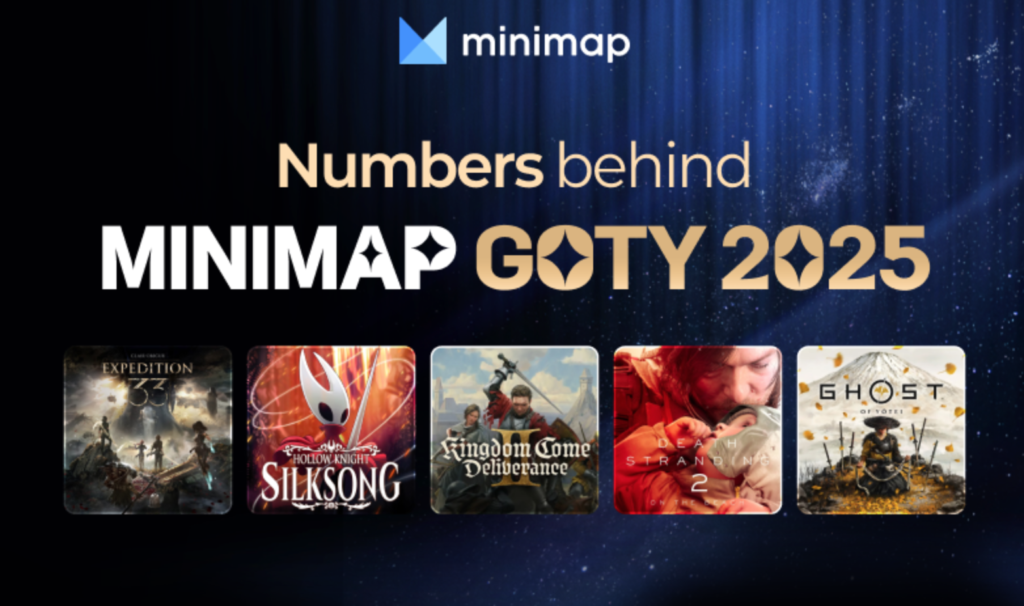
Minimap has released an in-depth analysis of player data focusing on the top 5 titles from its 2025 GOTY list. This report is based on 23,544 synced data points collected through the Minimap platform as of December 25, 2025…. Continue reading
Is This the End of Predetermined Scripts in Gaming?
Traditionally, the environments of games were painstakingly crafted and designed, long before a player ever pressed ‘start’. Dedicated artists, writers, and creatives, full of passion for their work, mapped out the environments, designed characters, storylines, and more. In practice, this approach could only ever create a limited number of pathways that players could take and, ultimately, this limited replayability. But that was no major problem, since the player would thereafter be on the hunt to buy the next title.
However, with the inevitable emergence of AI generated environments, characters and story arcs, the number of possibilities in any game has the potential to exponentially explode to near-infinity. If the player is cautious, the AI could create slow-burn, reflective narratives; if the player is high-octane and wreckless, then the AI could deliver thrilling plotlines full of tension and near misses. Every single play through could become a completely unique experience – and in many genres of gaming it’s hard to imagine how the traditional, pre-authored games would be able to compete.
Looking to the Future of AI-Generative Gaming
AI generated gaming isn’t just a niche trend that’s raising eyebrows amongst hardcore gamers on obscure internet chat forums; instead, it’s widely anticipated to emerge as a significant investment opportunity over the next decade. For instance, Precedence Research predicts the global AI-in-games market will sky rocket from around USD 7.05 billion in 2025 to USD 37.89 billion by 2034, representing an impressive 20.5% CAGR.
In-game AI-generated dialogue is also looking set for a boom of its own, with SNS Insider forecasting a surge from USD 1.59 billion in 2025 to USD 8.17 billion by 2033. Meanwhile, Grand View Research paints an even bolder picture, forecasting that AI-driven gaming could soar to USD 51.26 billion by 2033, fueled by a remarkable 36% compound annual growth rate.
As a consequence of the huge market potential of generative-AI, the dynamics of monetization in the gaming industry are bound to change. For example, instead of simply charging an up front price for a game title, players may be offered a variety of payment tiers or subscription models that reflect the quality and fidelity of the generative AI software they can access within a given gaming world. Alternatively, players may be able to buy different tiers of generative AI ‘add-ons’ to breathe new life into their favourite titles, and we might even see a black market of generative AI add-ons emerge in the darker corners of the internet.
As AI takes over more of the content generation in games studios, development teams are likely to transition from large asset-focused teams to leaner, AI-guided creative groups. Human designers may end up focusing less on producing the actual content and more on determining the generative AI’s boundaries in relation to ethics, tone, and the overall gaming experience.
But there are still major challenges to overcome, especially in more expansive and complicated gaming environments. Comprehensive narrative and storyline coherence, avoiding undesired bias in generative systems, and preventing “AI hallucinations” from breaking the in-game immersion are, for the time being at least, still out of reach.
Industry Milestone, or the Start of Something Much Bigger?
Wolf Games’ Public Eye is by no means the first experiment with AI-generated gaming, but it is the first fully realized, market ready AI-generative narrative game with serious industry backing. And that backing has only increased since its summer launch, as Wolf Games raised an additional $9 million USD and announced a content partnership with the media giant NBCUniversal, one of Hollywood’s ‘Big Five’ studios.
If Public Eye succeeds as a proof-of-concept test case, it could mark the moment when games stopped being static products and became living, adaptive worlds that grow alongside their players. And so we may be witnessing the early developments in a new era in gaming, a future in which you shape the game as much as the game shapes you.