

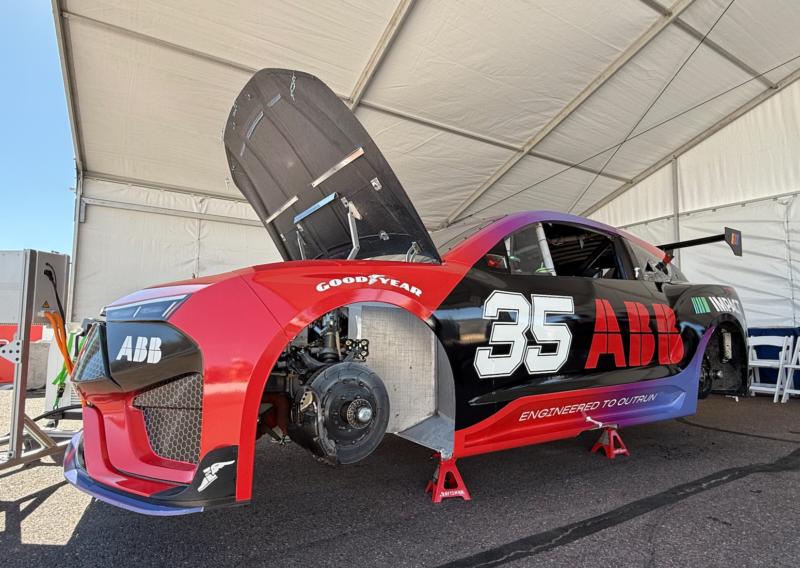
Prototype developed by NASCAR in partnership with their auto manufacturers Ford, Chevy, and Toyota.
Prior to attending NASCAR’s Championship Weekend in Phoenix, if you had asked me to draw some comparisons between the motor racing behemoth and the world of custom integration and residential technology the list would’ve been incredibly short. You can watch NASCAR on Sundays in your home theater and get an incredible AV experience. That might’ve been the start and end of it.
But, thanks to an invitation from the team at ABB—a Swiss-based tech company that specializes in many things, but mainly electrification and automation—I was able to see firsthand how their partnership with NASCAR is redefining not only the sport but the conversation around energy in the U.S.
Formally launched in July 2024, NASCAR and ABB have been working hand in hand to explore opportunities in high-performance electric racing and the electrification of the sport. The brands both have been adamant that the goal is to not turn NASCAR’s internal combustion-based stock car races into EV-powered events. Rather, they’re creating a space to have the conversation around electrification, spread knowledge about its potential and impact, and help advance NASCAR’s goal to reach carbon neutrality by 2035.
That seems like a lot to digest. But what I learned from the weekend is that the partnership can be summed up around two specific topics: 1) The car, and 2) the conversation.
The Car
NASCAR and ABB are actively working together to find ways to make the sport more energy efficient, from the at-track operations during a race weekend to how each race team can be more energy conscious over the course of a given weekend. It’s been a staple of the partnership, and one that’s already had some big impacts on the sport.
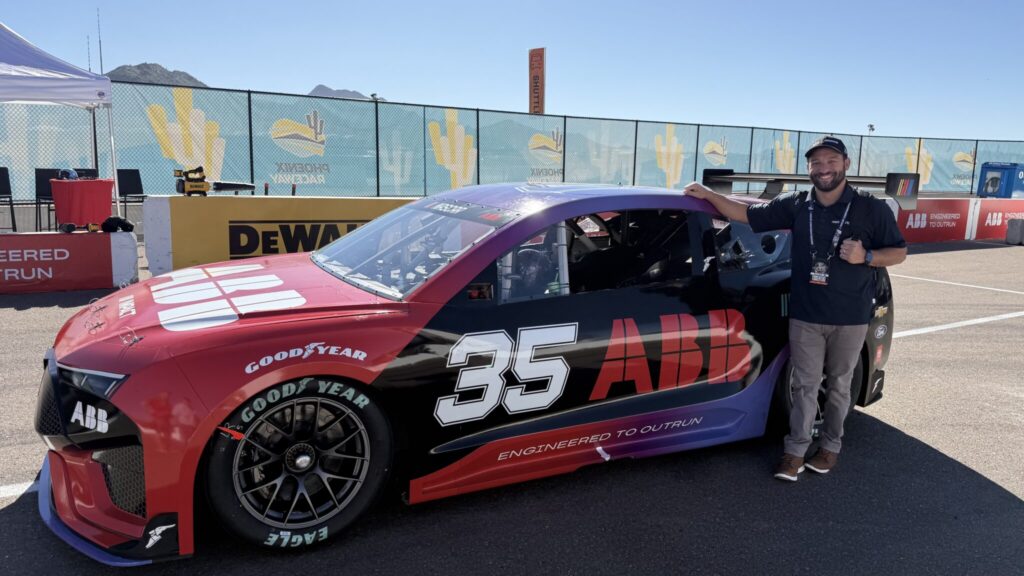
But, of course, the most obvious physical manifestation of the ABB-NASCAR relationship is the ABB-sponsored EV stock car prototype.
“This is one of the few cars you’ll ever see with three automaker logos on it [in Ford, Chevy, and Toyota],” explained Chris Shigas, head of electrification communications in the U.S. for ABB. “It was about NASCAR coming together with their automaker partners and saying, ‘Hey, let’s look at this technology and see what can do with it.’ We’ve been really testing the physics of this car to see where it performs well, where it doesn’t perform well, and really using every instance of it being on a track to learn. We see it as an opportunity to get behind the science of it and be a really strong partner for what NASCAR wants to achieve.”
Each of those automakers have since developed their own concept EV stock cars, but the OG EV prototype is what we were able to see up close in Phoenix. And to call it an engineering marvel would be nothing short of an understatement.
Built around the Next Gen chassis, the car features three electric motors (one in the front, two in the rear) that supply power directly to all four specially designed Goodyear Racing Eagle tires. The battery is a half-ton behemoth that’s positioned where a passenger seat would be in a typical street car. Encased in a specially designed protective barrier, the 78-kWh liquid-cooled battery is capable of producing up to 1,000 kW at peak power, which translates to some 1,360 horsepower—delivered directly to the wheels. It’s an all-wheel drive system that employs regenerative braking (a feature common in EV cars) that works to extend battery life.
When asked about the challenges of engineering a car that utilizes an entirely different propulsion system from what NASCAR is used to, the company’s Senior Engineer of Vehicle Systems CJ Tobin told me that there were many. Chief among them, though, was their attention to safety with where the battery had to be positioned, and figuring out proper weight distribution to keep the experience as close to familiar as possible for a driver.
“It’s basically a ripple effect, starting with the decision to put the battery on the righthand side of the car; it drove a lot of the decisions elsewhere,” Tobin said. “But then we go back to safety. These vehicles are going around tracks anywhere from a 180 to 200 mph in our cup series. Strenuous circumstances on their own, and then you add this big, combustible battery to the mix—so we had to make a lot of decisions with that in mind, ensuring it could withstand normal conditions and then impact in a potential crash.”
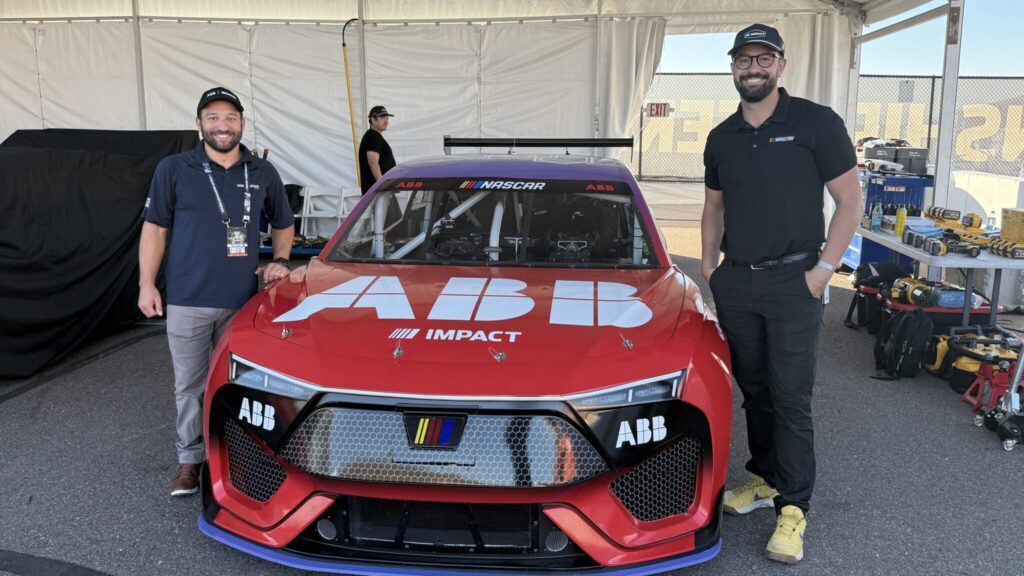
CJ Tobin (right) stands next to the EV prototype that he and his team have worked on for the better part of the past two years.
For Tobin, the opportunity to work closely with the ABB team—which also is the title sponsor for the Formula E series—has been among the biggest learning experiences for him and his team.
“We’ve had this car on track with a Formula E car, and the great thing to me as an engineer is that I got to nerd out with folks that only have ever worked in electric vehicles,” Tobin said. “At the same time, those open-wheel guys got to work with someone who’s only ever worked on one electric stock bar, but on internal combustion engines. So, that shared knowledge, although they are different in application, there’s so much we can learn from one another when it comes down to engineering.”
As for the sound produced by the EV prototype, it’s not the thunderous roar any NASCAR fan expects when a stock car is fired up on Sunday. But, to Tobin, the “banshee running out of hell” sound it does make is still incredibly “badass.” And even if fans will have some getting used to, to do here, it’s the fact that the car exists as a conversation starter that’s more important to him and their partners at ABB.
The Conversation
Arguably the bigger mission wrapped up in this ABB-NASCAR partnership is that of educating the consumer on the impacts and benefits of electrification.
To put our energy usage as a country into perspective, consider some of these facts:
In 1980, the average U.S. household consumed around 7,200 kWh of electricity per year. Today, that figure stands at roughly 10,332 kWh—a 44 percent increase, driven mainly by increased use in air conditioning, and the overall introduction of more power-hungry electronics.
Electricity demand in the U.S. is estimated to increase another 25 percent by 2030, and 78 percent by 2050 compared to today’s levels.
While not on the residential level, per se, the impact of AI on energy consumption has proven to be significant. In 2023, around 4.4 percent of all energy usage in the U.S. went towards data centers. An MIT Tech Review analysis found that by 2028, AI could consume as much electricity per year as roughly 22 percent of all U.S. households.
To the other end, smart home technology that targets energy efficiency has been found to reduce energy use by 30-40 percent in some cases. But that’s only if it’s deployed properly and doesn’t, in fact, have the opposite effect.
In our world, these numbers might carry some significance. But to the average consumer, the only impact they may see or understand is what they get in the mail in the form of a monthly electric bill.
From the beginning, ABB understood that, in order to have a meaningful conversation around electrification, they needed to bring their technology to the heart of America. And, frankly, there may be no singular place that’s more American on a Sunday afternoon between late February and early November than at a NASCAR track.
NASCAR driver Corey LaJoie sits to talk with fans after piloting the ABB EV prototype stock car during the Pit Stop Challenge at Phoenix Raceway.
“These fans care about energy, they care about the conservation,” Shigas said. “I think we have to learn as sustainability advocates to be able to speak in a language that is welcoming to everyone as we talk about the energy transition. Not just some people.”
And having that conversation, perhaps even forcing it in some ways, has been the exact result of bringing the EV prototype from track to track. ABB and NASCAR have had the car everywhere from Daytona (NASCAR’s mecca), to the streets of Chicago, to advocacy events, and everywhere in between. At each stop fans and consumers alike have come ready with questions about the performance of the car, the technology behind it, and much more.
“Whether this becomes anything more than a prototype that we can showcase, I love being able to have the conversation and seen fans’ reactions to the car and the technology,” says NASCAR’s Tobin. “Often they’ll come into the conversation with a specific notion about EV, and it’s inspiring to see that shift as they witness how the car performs. I tell them, you need to see it in person to understand it, and understand why this is such an important topic to both ABB and NASCAR. It’s easy for us to get excited about it, but it’s really about getting the fans excited too.”
As for this fan, mission accomplished.