

Among the Korean startups preparing to step onto the global stage at CES 2026. one company stood out for merging military-grade realism, accessibility, and social impact without relying on virtual reality headsets.
That company is Fake EYES, led by CEO Mason Kim. Its flagship offering is a highly realistic rifle shooting simulator that uses real firearms, advanced ballistics, and AI-driven environment. All of these elements while remaining fully indoor, controlled, and accessible. The result is an experience that feels closer to live-fire training than anything typically labeled “simulation.”
A New Approach to Shooting Simulation
Most shooting simulators fall into one of two camps: basic static target systems or immersive VR experiences that trade realism for convenience. Fake EYES takes another path that prioritizes physical realism without head-mounted displays.
“Our goal is to make training more realistic, more fun, and above all more accessible,” Mason Kim explained.
Fake EYES’ system allows shooters to operate in a physical space of approximately 100 meters while simulating targets at distances of up to one kilometer. This is achieved through a combination of high-resolution projection screens, precision cameras, motion tracking, and proprietary ballistic algorithms. The system continuously calculates rifle angle, shooter position, and environmental variables, translating real-world movements into long-range virtual outcomes.
Crucially, no VR headset or individual screens are required. Instead, shooters engage with a large, shared projection environment paired with a motion simulator. This effectively reduces fatigue, increasing situational awareness, and making the experience suitable for group training.
Military-Grade Technology, Proven in the Field
Fake EYES’ technology is not theoretical. The system is already in use by the Korean military, where realism, reliability, and safety are non-negotiable. Unlike many simulators that rely on replicas, Fake EYES supports the use of real firearms, firing blank rounds or specialized ammunition.
The training environment is fully soundproofed and reinforced with bullet-resistant materials, enabling safe indoor operation even in dense urban areas. This dramatically reduces the logistical burden of traditional shooting ranges, which require large outdoor spaces and strict zoning.
“We enable shooting at one kilometer in a 100-meter room,” Kim said. “Without VR. Using your real rifle. That level of realism is what people respond to.”
The system supports dynamic scenarios rarely available in conventional ranges: moving targets, variable terrain, adjustable difficulty levels, and real-time weather simulation including wind and visibility changes. Virtual elements, such as animals or non-player characters, can be introduced to diversify training scenarios for military, law enforcement, or sport shooting applications.
Reducing Cost, Increasing Capability
Beyond realism, Fake EYES addresses two major pain points in shooting training: cost and scalability. Live-fire exercises consume ammunition quickly and require significant space and staffing. By contrast, Fake EYES’ simulator allows repeated, varied training sessions with minimal consumable cost.
For special forces and tactical units, this enables more frequent scenario-based drills. For civilian shooting clubs, it offers something equally compelling: a richer, more engaging experience that goes far beyond static paper targets.
“This isn’t about replacing real-world training,” Kim emphasized. “It’s about enhancing it, making practice more efficient, safer, and more versatile.”
CES Innovation Award Honoree OTITON Uses AI to Bring ENT Diagnosis Into Home Healthcare
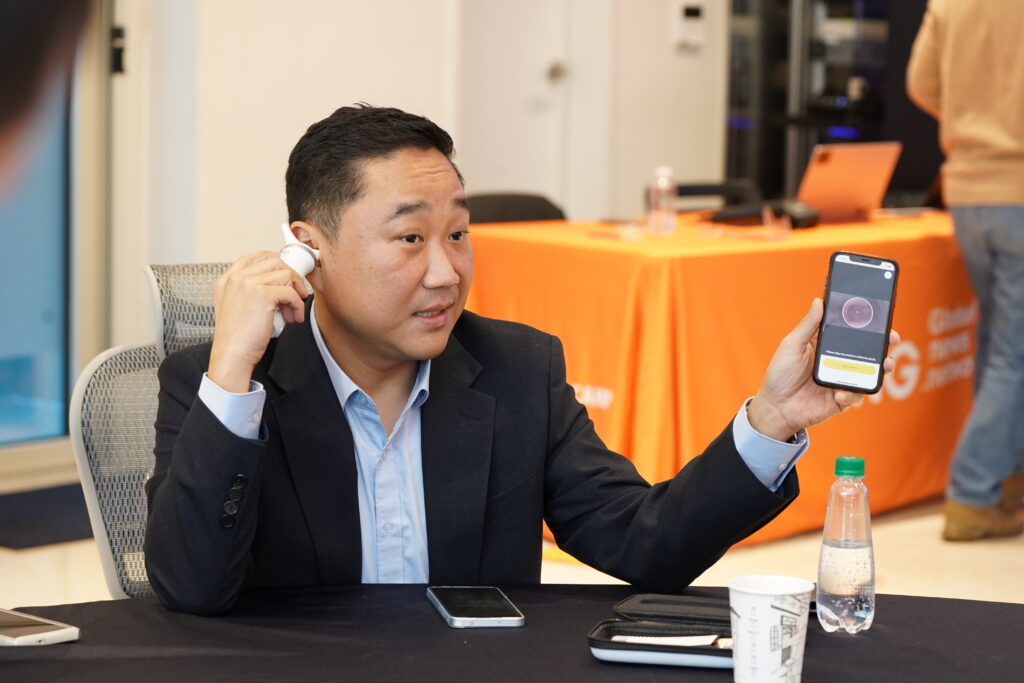
A Korean startup stands out for addressing a challenge that nearly every family knows all too well: how to quickly and confidently assess common health issues without rushing to an overcrowded hospital. That company is OTITON… Continue reading
Expanding Beyond Defense
While military applications were the initial focus, Fake EYES is now broadening its scope. Civilian shooting clubs represent a significant opportunity, particularly in markets like the United States, where shooting sports are widespread but often rely on outdated range formats.
“In the U.S., many clubs still use static targets,” Kim noted. “We offer a living environment that reacts, changes, and challenges the shooter.”
By introducing moving targets, simulated environments, and competitive or cooperative modes, Fake EYES aims to transform shooting practice into an immersive, skill-building experience that appeals to enthusiasts as well as professionals.
Technology With a Social Mission
Perhaps the most unexpected dimension of Fake EYES is its work in assistive technology. Alongside its simulation platform, the company is developing an AI-powered assistive device for people with visual impairments.
The portable system, currently in the final stages of development, uses cameras and AI to identify obstacles in real time and deliver audio guidance to the user. The goal is to improve mobility and independence, particularly in unfamiliar environments.
“This project is more social than profitable,” Kim said candidly. Fake EYES intends to distribute the device through government programs rather than commercial retail channels, prioritizing impact over revenue.
This dual focus on defense-grade simulation tied with inclusive technology underscores the company’s broader philosophy: advanced technology should be both powerful and purposeful.
The Border of Reality and Simulation
Fake EYES’ presence at CES 2026 in Las Vegas marks a critical milestone. The event offers the company a platform to introduce its technology to international defense partners, shooting sports organizations, and accessibility advocates.
For a startup fusing defense, entertainment, and social innovation, global visibility is essential. CES provides exposure along with validation through opportunity to demonstrate that Fake EYES’ approach is scalable. At the same time, its commitment to accessibility in training environments and through assistive technology sets it apart in a field often dominated by purely commercial or military priorities. Whether on the range, in a training facility, or in daily life for visually impaired users, Fake EYES is proving that realism and responsibility can coexist.
Fake EYES exemplifies a new generation of Korean startups: agile, technically sophisticated, and unafraid to challenge entrenched assumptions. By removing VR headsets from the equation and embracing physical realism, the company is redefining what immersive simulation can look like. At CES 2026, immersive shooting has found a new future without needing a headset to engage.