


One startup, working at the cutting edge of emerging technologies, aims to transform the physical connections that underpin nearly every electronic device we use today. Founded in 2022, Uniqconn is pursuing a bold and deceptively simple ambition. The goal is to “make wireline interfaces wireless” as their CEO, YD Kim, succinctly put it.
At first glance, the idea seems almost obvious. Why, in a world dominated by wireless networks, are our most critical interfaces (USB, HDMI, Ethernet, MIPI) still tethered by cables? The answer, as Kim explained, lies in physics and performance. Existing wireless standards such as Wi-Fi, Bluetooth, or NFC simply cannot guarantee the combination of ultra-low latency, high bandwidth, and stability that these interfaces demand. Uniqconn’s mission is to overcome that barrier to redefine how devices connect at the most basic hardware level.
Ambitions to Eliminate Cables
Uniqconn was born around a single, sharply defined idea to eliminate cables where current wireless technologies fall short in high-speed, low-latency interfaces. This clarity of purpose has guided the company through a period that has been particularly challenging for hardware startups, which require significant capital, long development cycles, and close coordination with manufacturing partners.
Despite these obstacles, Uniqconn has made steady progress in its first three years. The company has raised more than $25 million, grown to a team of 47 employees, and established offices not only in South Korea but also in China, Japan, and the United States. Kim jokes that the company’s work may not sound “sexy” compared to AI hype cycles, but the traction suggests that industry players recognize the transformative potential of solving this problem.
The long-term vision is ambitious: a new universal standard that could replace the short cables we use every day. Imagine a world without ports or connectors, where a smartphone snaps into a module, a laptop hinge transmits data without physical pins, or an industrial robot swaps tools without exposed contacts. Kim sums it up in four words: “A world without cables.”
Technology Designed For Speed and Stability
At the core of Uniqconn’s solution is a millimeter-wave integrated circuit operating in the 60 GHz band. Manufactured by TSMC, the chip is capable of transmitting data at speeds of up to 5 Gbps with near-zero latency. This combination is what enables the technology to behave more like a virtual physical cable than a traditional wireless link.
The operating principle is deliberately simple. There are no heavy network stacks, no complex protocols, and no negotiation layers. The data stream is raw and binary, mirroring the behavior of a direct wired connection. This simplicity is what gives the system its stability, even in environments saturated with other wireless signals.
In its current form, the natural operating range is between 5 and 10 centimeters, though it can be extended up to two meters with more powerful antennas. For many intended applications, this short range is not a limitation but an advantage. Smartphones, for example, already rely on magnets for alignment, meaning that even sub-centimeter distances are sufficient. The result is a highly controlled, interference-resistant link that activates only when two devices are intentionally brought together.
Functional Light Brings Brain Wellness and More
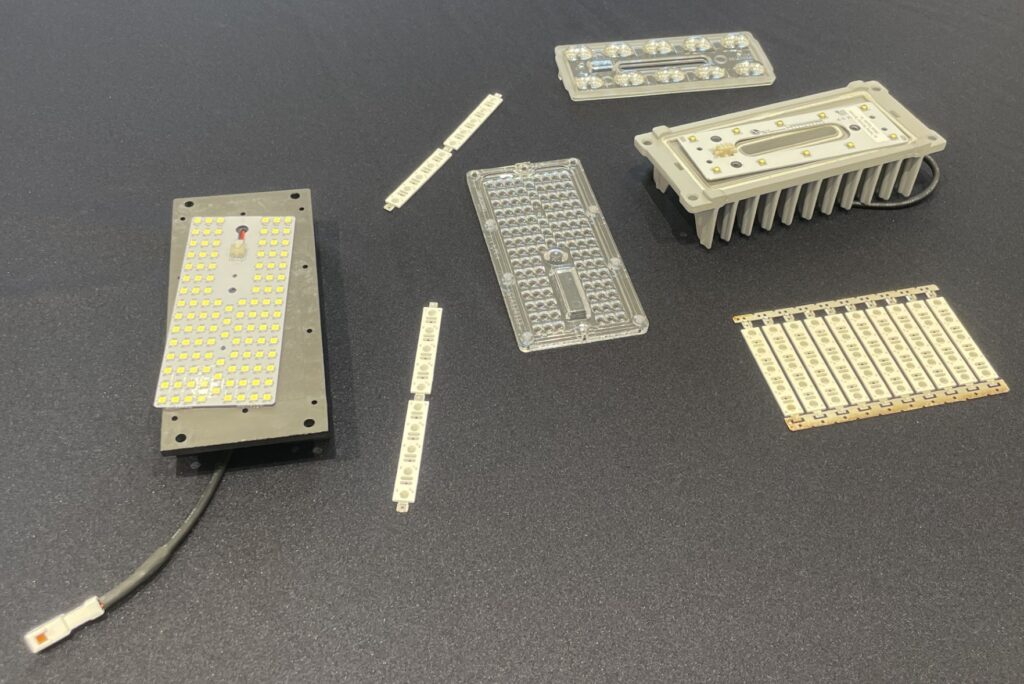
Korea Lighting demonstrated how functional light is moving beyond traditional LED applications into brain wellness and daily health. The company, with more than 15 years of research and development, is using its proprietary semiconductor platform to deliver… Continue reading
From Detachable Cameras to Industrial Robots
The implications of this approach span both consumer and industrial markets. Potential applications include detachable high-resolution cameras, wireless solid-state drives, modular smartphone components, and cable-free laptop hinges. In industrial settings, the technology could enable robots with interchangeable modules, reducing wear and tear on connectors and simplifying maintenance.
The comparison with NFC inevitably comes up in these discussions. Conceptually, both technologies enable data transfer through proximity. In practice, however, the difference is vast. “NFC is kilo. We are gigabits. It’s another world,” Kim said. That leap in bandwidth means that entire interfaces from high-definition video streams, large data sets, even 3D models can be transmitted instantly by simply touching or docking two components together.
This capability also has implications for device design and repairability. By eliminating fragile physical connectors, manufacturers could create more modular products that are easier to assemble, disassemble, and repair. Kim argues that with Uniqconn’s IC, “self-repair is very easy,” because precise alignment of delicate pins is no longer required.
Mass Production and A Public Showcase
After three years of development and prototyping, Uniqconn is now entering the critical phase of mass production. According to Kim, one million ICs are currently being manufactured, with the first deliveries scheduled for January. This scale-up is a major milestone, as it allows partners to test durability, thermal performance, and long-term reliability across thousands of units. This essential step ensures a technology can be integrated into mainstream products.
The company already has its first customers lined up, though their identities remain confidential due to non-disclosure agreements. Kim hints that one smartphone manufacturer and one laptop maker will showcase products using Uniqconn’s technology at CES, offering the public its first glimpse of what a cable-free interface might look like in practice.
Beyond consumer electronics, discussions are being held with major AI and data center players. While these applications are further down the road, the potential benefits are significant: fewer internal cables, reduced risk of breakage, improved airflow, and simplified maintenance in dense server environments.
A Wireless, Portless Future
Looking ahead, the company hopes to build a full ecosystem around its technology, known as UniQ. Rather than positioning itself as a closed solution, Uniqconn envisions manufacturers, designers, and system integrators adopting UniQ as a shared standard that sits alongside, or even replaces, today’s familiar wired interfaces.
If Uniqconn succeeds, the impact could ripple far beyond convenience. Devices could become more modular, more repairable, and more adaptable. Concepts that arrived too early might finally find the technical foundation they need to succeed.
While it may not fit the current definition of a “sexy” startup, its work targets one of the most fundamental layers of modern hardware: physical connectivity. By rethinking how devices talk to each other at close range, the company could unlock a new wave of innovation in design, manufacturing, and user experience.
A wireless world, in every sense of the word, may be closer than we think.